By Adil Hasan, Co-Founder at Phnix tech, with 10+ years managing and running Apps, Digital Marketing & Website Development Company. Last updated: September 2026
Picture a Parramatta business owner asking ChatGPT, "Who is the best commercial electrician in Western Sydney?" Or a North Shore homeowner searching Google and seeing an AI-written summary that names three local firms. If your business is not one of those names, you have lost the customer before they ever saw your website, even if you rank on page one below the summary.
That is the problem AEO/GEO solves. AEO/GEO, short for Answer Engine Optimisation and Generative Engine Optimisation, is the practice of making your business easy for AI tools to find, trust and recommend. This guide explains how it works, how it fits with the SEO you may already be doing, and gives you a practical ten-step playbook for Sydney businesses.
One honest note first: no one controls what ChatGPT or Google's AI Overviews say. Anyone who guarantees you a citation is guessing. What you can do is make your business the clearest, most verifiable answer to the questions Sydney customers ask.
AEO (Answer Engine Optimisation) is optimising your content so it can be used as the direct answer to a question, for example in a Google AI Overview or featured snippet.
GEO (Generative Engine Optimisation) is optimising so generative AI tools such as ChatGPT, Gemini, Perplexity and Microsoft Copilot mention or recommend your business when they build an answer.
The two overlap heavily, and most agencies use the terms interchangeably. In this article, AEO/GEO means one thing: earning mentions and citations in AI-generated answers.
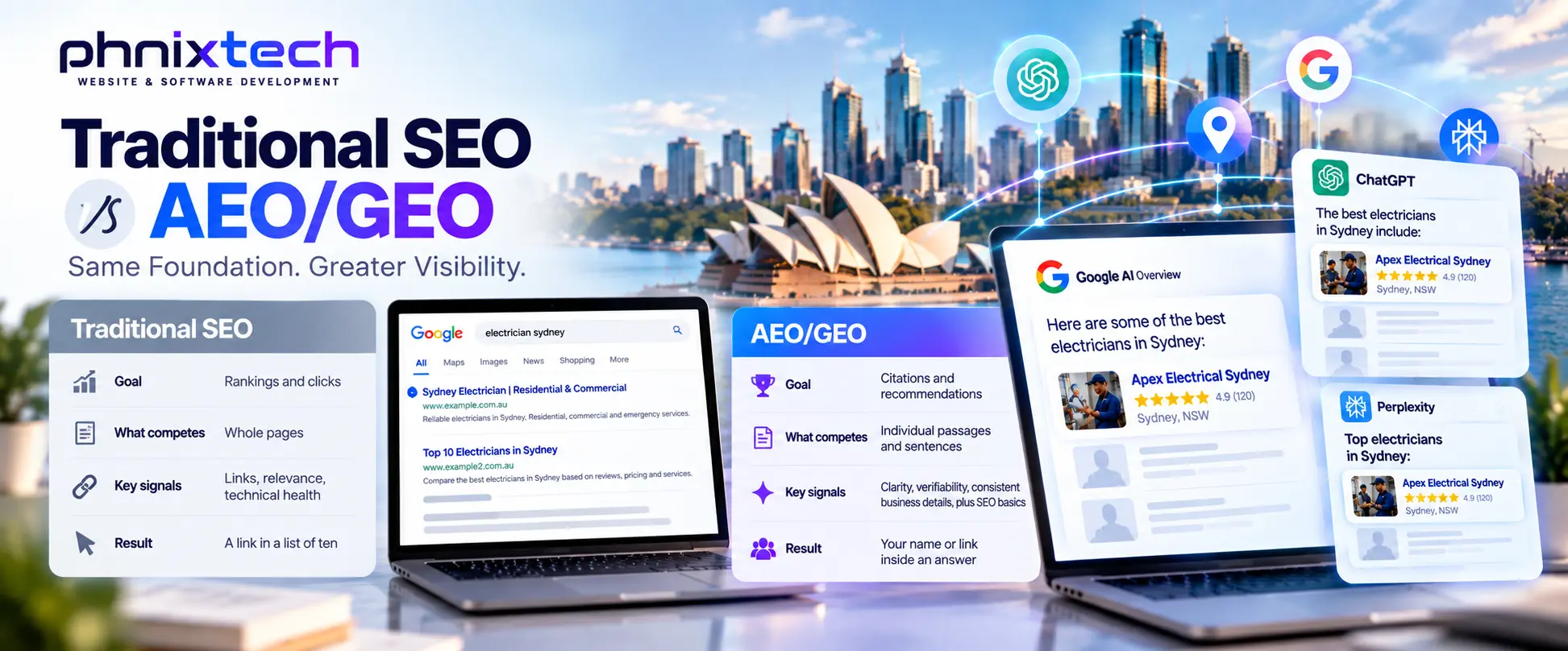
| Traditional SEO | AEO/GEO | |
|---|---|---|
| Goal | Rankings and clicks | Citations and recommendations |
| What competes | Whole pages | Individual passages and sentences |
| Key signals | Links, relevance, technical health | Clarity, verifiability, consistent business details, plus SEO basics |
| Result | A link in a list of ten | Your name or link inside an answer |
AEO/GEO builds on SEO rather than replacing it. Pages that rank well are generally better placed to be cited, because AI search tools draw on much of the same web content and retrieval systems. If your foundations are shaky, start with strong SEO services in Sydney, then layer AEO/GEO on top.
Sydney is one of the most competitive local markets in Australia. Whatever your field, you are likely up against dozens of similar businesses within a short drive. Three shifts make AI search worth your attention.
Customers ask AI for recommendations. People increasingly type full questions into ChatGPT and Google: "Which accountant in the CBD works with small startups?" or "Best Shopify developer in Sydney?" The answer arrives as a short list, not ten links to compare.
Fewer clicks reach traditional results. When an AI summary answers the question on the results page, some people never scroll further. Being cited in that summary is the new equivalent of being at the top of page one.
The field is still open. Most Sydney small and medium businesses have not optimised for AI search yet. Early movers can build a lead that later arrivals find hard to close.
None of this means SEO is dead. It means visibility now has two layers: ranking, and being named.
You do not need to understand the technology in detail, but you do need the practical picture.
Google AI Overviews appear on the search results page. Google has said that to be included in its AI features, a page needs to be indexed and eligible to show in Search with a snippet, and that no special markup is required. In other words, normal SEO health is the entry ticket.
ChatGPT search retrieves live web content when a question needs current information. OpenAI publishes documentation for a crawler called OAI-SearchBot, which relates to whether a site can appear in ChatGPT search results. Blocking it can opt you out.
Perplexity and Copilot retrieve pages, extract passages and cite the ones that answer the question best.
Across these tools, three qualities keep appearing in what gets cited:
The playbook below is built around those three.
This is the cheapest win and the one most often missed. Open yourdomain.com.au/robots.txt and confirm you are not blocking the bots behind AI search:
Many businesses allow search crawlers so they can be cited, while deciding separately about training crawlers. Check each provider's current documentation, because names and behaviour change.
Also check that your key content appears in the page's raw HTML. Sites that rely heavily on JavaScript to display text can look empty to some crawlers. Security plugins and CDN rules sometimes block bots without you knowing, so ask your developer to test. If your site needs a rebuild to fix this, our website design team can help.
AI tools favour pages where the question is asked and answered straight away. Structure your service pages and posts like this:
Before: "At our firm, we believe every client deserves a tailored approach that reflects their unique goals..."
After: "A custom business website in Sydney typically costs between $[X] and $[Y] AUD, depending on page count, integrations and whether it includes e-commerce. Most projects take [X to Y] weeks."
The second version can be quoted as it stands. The first cannot. Use your real prices or, if you do not publish them, the factors that drive them.
Read your key paragraphs and ask whether a single sentence could be lifted into an answer and still make sense. Aim for:
Compare "We offer best-in-class local SEO solutions" with "Local SEO is the process of optimising a business's online presence so it appears in map results and searches with a geographic intent, such as 'plumber in Blacktown'." Only the second is worth citing.
Schema markup labels your content in a format machines read easily. Prioritise:
Google has scaled back FAQ rich results for most sites, so do not expect visual snippets. The value now is helping machines understand you. Test with Google's Rich Results Test and make sure the markup matches what is visible on the page.
AI systems cross-check sources. If you are "Smith & Co Accountants" on your site, "Smith and Company" on Facebook and "Smith Accounting Services" in a directory, you look like several uncertain businesses rather than one confident one.
Standardise:
sameAs in your Organization schema.For Sydney businesses, start with your Google Business Profile. Choose accurate categories, list your service areas by suburb, add photos and keep hours current. Then align LinkedIn, Facebook and any Australian directories you use. This is the heart of local SEO, and it feeds AI answers directly.
AI tools and Google's quality guidelines both reward content from identifiable people with first-hand experience. Add:
If you have delivered 200 projects across Sydney, say what you learned. Generic advice can be produced by any AI; your specific local experience cannot.
AI answers lean on agreement between independent sources. If only your own site says you are excellent, that is weak evidence. If your site, client reviews, a directory listing, a local news mention and an industry association page all describe you the same way, that is strong evidence.
Practical Sydney-friendly options:
This is digital PR and reputation building. It matters more in AEO/GEO than most business owners expect.
AI tools often split a question into related sub-questions and retrieve for each. A page that answers the main question and the obvious follow-ups is more likely to be picked.
If you sell e-commerce websites, for example, cover: cost in AUD, timelines, platform choice (Shopify or WooCommerce), payment and shipping setup for Australia, GST handling, and what to prepare before starting. Then link those pages together in a cluster, as this post links to our main SEO page.
Avoid hiding important facts inside images, PDFs or collapsed elements that crawlers may skip. Plain HTML text is safest. If your site is slow or hard to read on mobile, fix that too: good digital marketing cannot fix a poor site experience.
AI search favours fresh, accurate information. Review your top pages each quarter, update prices, screenshots and statistics, and change the "last updated" date only when you have made a meaningful change. Out-of-date information hurts trust with customers and machines alike.
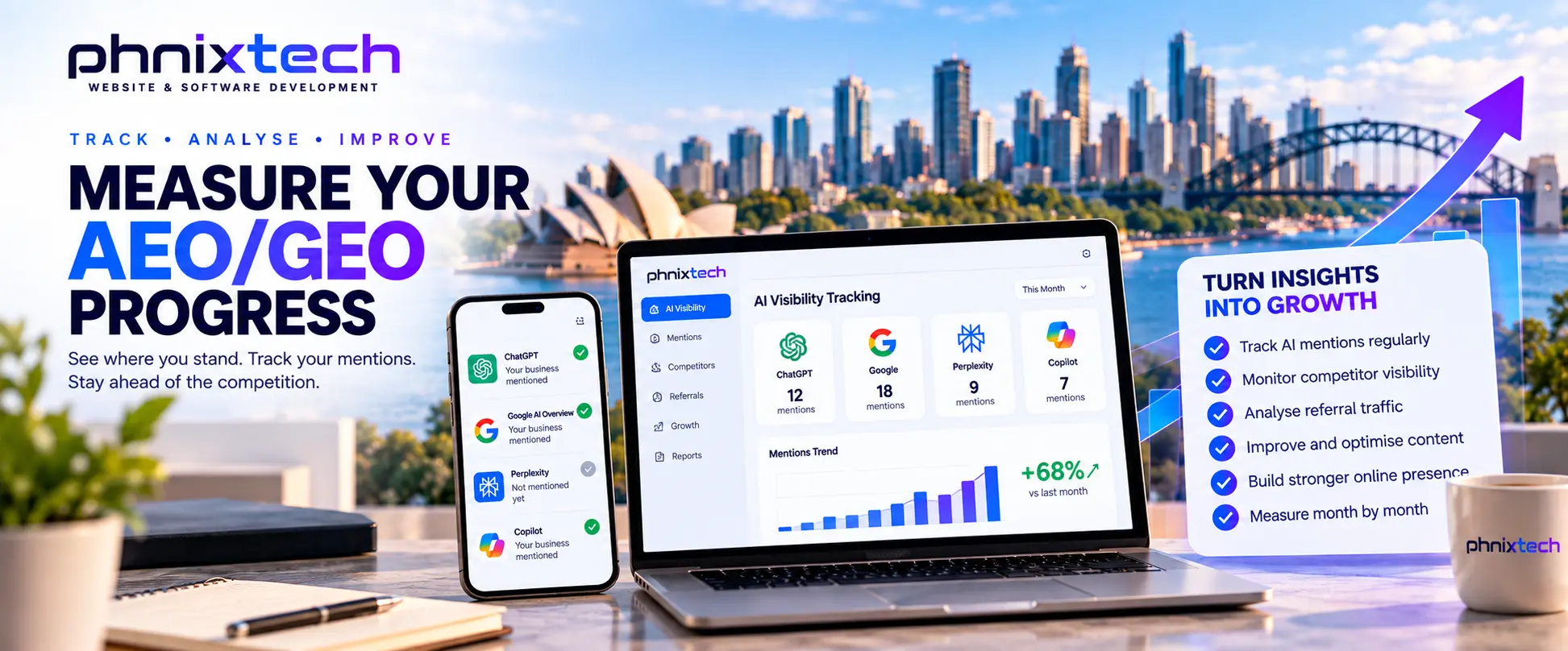
Tracking tools for AI citations are emerging, but a manual method is free and revealing. Run this monthly:
AI answers vary between runs, so look for trends over several months rather than reacting to a single result. Also check your analytics for referral traffic from chatgpt.com, perplexity.ai and similar sources, and watch branded search impressions in Google Search Console.
Days 1 to 30: Foundation
Days 31 to 60: Content
Days 61 to 90: Authority
Early movement often shows first on local or lower-competition queries, while broader gains typically take several months. Results vary by industry and competition.
AEO focuses on being chosen as the direct answer in features such as Google AI Overviews and featured snippets. GEO focuses on being cited or recommended by generative AI tools such as ChatGPT and Gemini. The tactics overlap heavily.
No. It extends SEO. Strong rankings, quality content and technical health remain the base.
No. No one controls AI outputs. You can improve your chances by making your content accessible, clear and well corroborated.
If you want to be eligible for ChatGPT search results, check OpenAI's current documentation and allow it. Decide separately about training crawlers.
Google says no special markup is required, but structured data helps search systems understand your content and is low cost. It is worth doing.
Some improvements can appear within weeks on local or niche queries. Broader visibility usually builds over three to six months.
Yes, particularly for local and specialist businesses, where customers already ask AI tools for recommendations and competition for citations is still limited.
Not always. Many gains come from fixing crawler access, rewriting key pages and cleaning up business listings. A rebuild makes sense if your site is slow, hard to crawl or difficult to update.
AEO/GEO comes down to a simple idea: be the clearest, most credible answer to the questions Sydney customers ask, and make that answer easy for machines to find and quote. Open the door to crawlers, write direct and specific content, keep your business details identical everywhere, and earn mentions from trusted local sources. Then measure, refine and repeat.
Phnix Tech is based in Auburn and works with Sydney businesses on SEO, websites and digital marketing. If you would like a practical review of how visible your business is in Google and AI search, explore our SEO services in Sydney or get a quote.