By Adil Hasan, Co-Founder at Phnix tech, with 10+ years managing and running app & website development company. Last updated: September 2026
Here's an awkward truth about searching for help with your online store. Almost every guide you'll read on "how to choose an agency" was written by an agency hoping you'll choose them. It's a bit like asking a barber whether you need a haircut. So let's do this differently. Grab a coffee, and we'll walk through how to actually vet a team, using the real, spot-it-yourself signs that separate the good ones from the ones who'll cost you money and sleep.
Choosing an ecommerce web design agency in Sydney really comes down to four things: a real portfolio you can click through, pricing that's clear and consistent, genuine expertise in the platform your store will run on, and a straight answer about what happens after launch. Nail those four and you'll dodge almost every common mistake. The rest of this guide shows you exactly how to check each one.
A portfolio is the easiest thing in the world to fake, and the easiest thing to check if you know what to look for. Pretty screenshots on a page prove nothing. Anyone can borrow an image or mock up a design that never went live. What you want is proof that real stores, built by this team, are out there working right now.
When you look at an ecommerce agency portfolio, run through this quick checklist:
If a team gets cagey when you ask for live links or names, that's your first useful signal. Move on.
Pricing is where a lot of the truth comes out, if you're paying attention. A trustworthy ecommerce web design agency in Sydney will explain its pricing clearly and stick to the same story everywhere. When the numbers get slippery, so does everything else. Keep an eye out for these:
You're not looking for the lowest number. You're looking for the clearest one. Clarity now is the best predictor of clarity later.

Most agencies have a favourite way of building, and there's nothing wrong with that. The problem starts when they recommend whatever they happen to build by default, regardless of whether it fits your business. A team that only knows one tool will tell you that tool is perfect for everyone. It isn't.
The big three options are Shopify, WooCommerce, and a fully custom build. Each suits different businesses. Shopify is quick and reliable for many stores. WooCommerce offers more control if you're on WordPress. A custom build makes sense when your needs are genuinely unusual. A good Shopify and WooCommerce agency in Sydney will happily walk you through the trade-offs rather than steering you toward their comfort zone.
Ask these questions and listen carefully to the answers:
If they can explain honestly when their preferred platform is the wrong choice, you've found someone worth trusting.
Plenty of agencies are brilliant right up until your site goes live, then vanish. The weeks and months after launch matter just as much as the build, so pin these down before you sign:
Here's a small tell that reveals a lot. Read their website and case studies closely. Do they mention real websites with real clients, actual business names, specific suburbs, or local details? Or is it generic copy that could belong to any agency in any city on earth?
A team genuinely working in Sydney will have local stories to tell, clients you might even recognise, and an understanding of the market you're selling into. Copy that's been clearly swapped out from a template, with "your city" energy and no real local proof, suggests they're casting a wide net rather than doing the work on the ground. It's not proof of anything on its own, but paired with the other checks here, it helps you tell a local partner from a faceless order-taker.
Some warning signs aren't worth a second meeting. If you spot any of these, trust your gut and keep looking. There are plenty of good agencies out there.
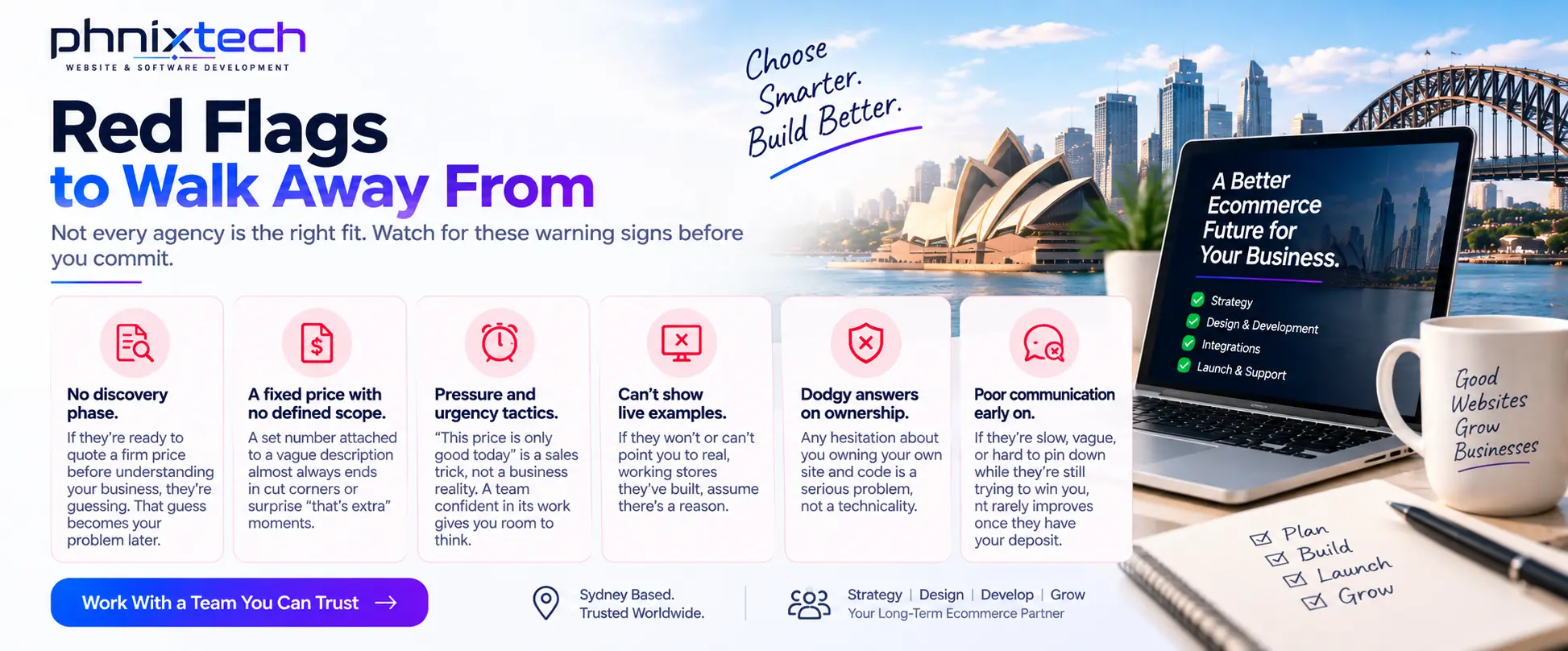
Before you put your name on anything, run through this short list. The answers will tell you almost everything you need to know.
If an agency answers all four clearly and in writing, that's a very good sign. If they get vague on any of them, ask again, and watch how they handle it.
A good ecommerce web design agency in Sydney should have a real portfolio with live links, clear and consistent pricing, genuine experience in your platform, and honest post-launch support terms. Above all, look for a team that explains things plainly and lets you own your own website, code, and design files.
Most ecommerce websites in Sydney range from around $5,000 to $15,000 or more, depending on your products, features, and how custom the build is. Simpler stores sit at the lower end, while large catalogues, custom checkouts, and integrations push the price up. Watch for ongoing costs like hosting and app fees too.
For a serious online store, a team with real ecommerce experience usually beats a generalist. Stores have their own quirks around payments, inventory, and checkout that a general web designer may not have handled. If a generalist can show relevant, live ecommerce work, they're worth considering. If not, lean specialist.
Ask who owns the finished site and code, what the realistic timeline is, what support you get after launch and its later cost, and, most importantly, what is not included in the quote. Clear answers in writing are a strong sign. Vague or defensive answers are a reason to keep looking.
Ask for live web addresses and visit them yourself, rather than trusting screenshots. Check the work matches your industry or complexity, and ask who on the current team actually built it. Real Sydney client names and local detail are a good sign. Cagey, generic answers are not.
If you'd rather skip the vetting and talk to a Sydney-based team directly, our ecommerce web design agency page covers our process, pricing, and past work. Full disclosure: Phnix Tech is an ecommerce agency too, so we've got skin in the game. But everything above is exactly what we'd tell a friend before they signed with anyone. Prefer to just get numbers? Grab a free quote.
Weighing up an app as well? Our app development cost guide takes the same honest, no-sales-pitch approach.