Short answer: Professional services web design in Parramatta means building a fast, credible website for law, accounting and advisory firms that respects your advertising and privacy obligations and turns local searches into enquiries. Most firm sites cost $3,500 to $8,000 and take 4 to 8 weeks from brief to launch.
Nobody picks a lawyer or an accountant from one website. They search, open three or four firms in separate tabs, and give each one a few seconds to prove it's competent, safe to deal with, and easy to contact. That snap judgement is your website's job now, and for most firms it happens well before the phone rings.
So building for a firm is not the same project as building for a café or a tradie. You're selling trust, you work under professional rules that govern how you advertise, and the information your clients hand over is sensitive. This guide walks through what a law or accounting firm's website has to do, the traps it has to avoid, what it costs, and how clients around the Parramatta CBD actually find you.
This is general information, not legal or tax advice. Confirm the specifics with your professional body or adviser.
Three things separate a firm's website from an ordinary business site.
The decision is high-trust and high-stakes. The person choosing a family lawyer, a conveyancer or a tax accountant is usually under some stress, and the engagement isn't cheap. They want evidence: who you are, what you've handled, and what actually happens when they make contact. A stock photo of a handshake tells them none of that.
You answer to rules a normal business doesn't. Solicitors, tax agents and financial advisers each carry obligations about how they advertise and how they treat client information. A website is advertising. When it crosses a line, it's the practitioner who wears it, not the agency that built the page.
The buying journey is longer and more specific. Almost nobody searches "lawyer". They search a problem: "employment lawyer Parramatta", "SMSF accountant near me", "tax return Westmead". One catch-all "Services" page can't answer searches like those. Giving each service its own page is what lets you rank for law firm and accountant website design queries in your area, and it's the foundation everything else sits on.
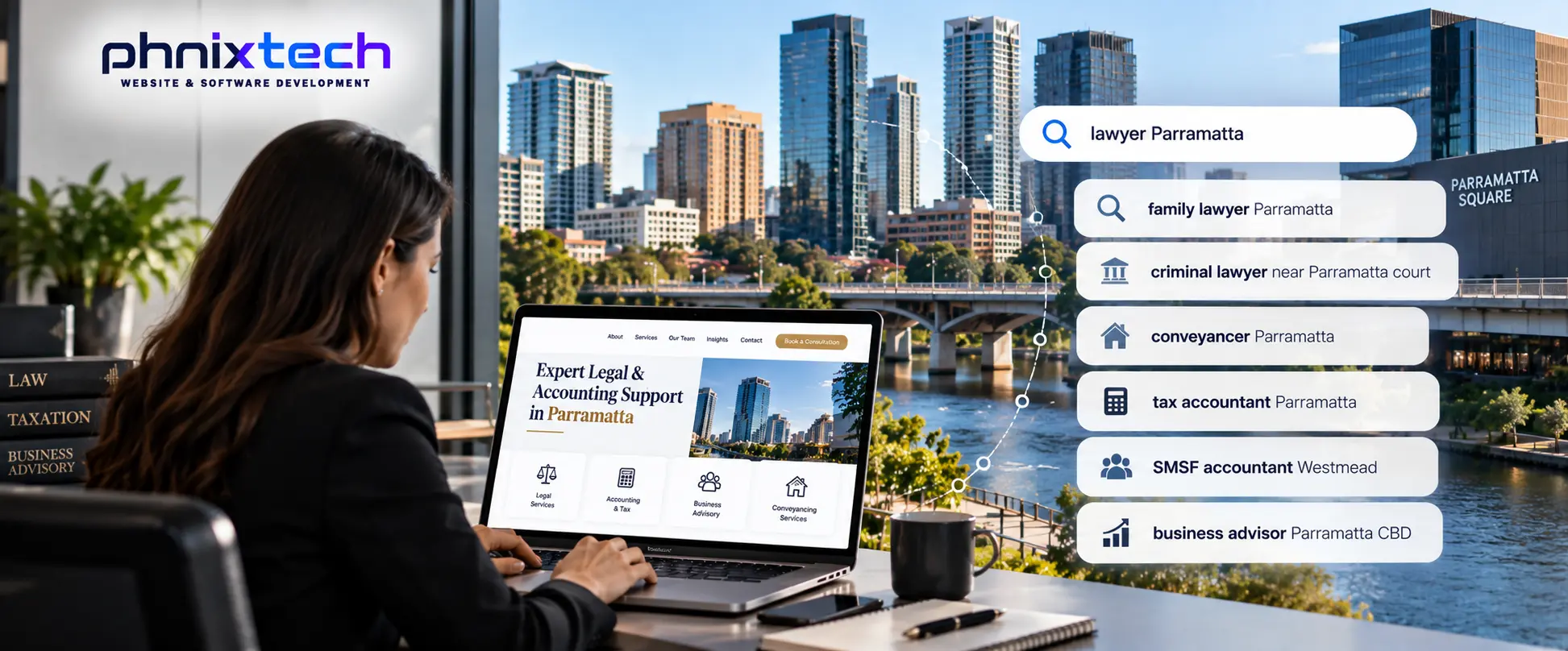
Parramatta is Sydney's second CBD, and its legal and commercial life clusters in a handful of places: the Justice Precinct on George Street, Parramatta Square and the towers around it, and the Westmead health and education precinct to the west. People search the way they live and work, so your site should line up with that.
What the client types | What they need from your site |
| "family lawyer Parramatta" | A family law page, the team member who runs it, and how a first appointment works |
| "criminal lawyer near Parramatta court" | A page naming the courts you appear in, with a clear after-hours contact |
| "conveyancer Parramatta" | Fixed-fee or fee-guide information, and a short quote request |
| "tax accountant Parramatta" | Your registration details, services for individuals and businesses, and tax-time deadlines |
| "SMSF accountant Westmead" | A dedicated SMSF page, and the suburbs you serve with a reason for each |
| "business advisor Parramatta CBD" | Case examples, the industries you work with, and how to book a consult |
Every one of those queries points at a different page, and that's the gap on most firm websites. It's also where the typical "Parramatta web design" page goes quiet. Agency pages love to dump a block of suburb names as a keyword list. Google's spam policies specifically target thin, near-duplicate location pages, so steer clear of that. Name a suburb only when you can say something true about it: an office there, a court or council you deal with, a client type you serve. Harris Park, North Parramatta, Granville, Auburn and Lidcombe earn a place on your site only if you genuinely work in them.
Compliance is where a professional services website can fail in ways an ordinary one never will. Treat this table as a starting point and confirm each line with your professional body.
Area | What to check on your website | Why it matters |
| Advertising (solicitors) | Nothing false, misleading or deceptive, likely to mislead, offensive, or prohibited by law. Be careful with "best", "specialist" and "expert", and with results you can't back up. | Rule 36 of the Australian Solicitors' Conduct Rules covers advertising, and practitioners are personally responsible for marketing done on their behalf. See the Law Society of NSW advertising page. |
| Testimonials and reviews | Confirm what your professional body allows before you publish client quotes, and make sure any quote is genuine and not misleading. | The test is the same one: advertising must not mislead. |
| Tax agent registration | If you advertise tax agent or BAS services, you must be registered. Where you use the Tax Practitioners Board registered tax practitioner symbol, it must appear with the registration number, and a firm uses its own number, not an individual partner's. | The TPB sets out how the symbol and number may be shown. Check the current TPB symbol guidelines. |
| Privacy | A clear privacy policy, a collection notice on every form, and a plain statement of what happens to enquiry details. Firms handling tax file numbers carry extra obligations. | Clients are sharing sensitive details, and a breach costs you far more trust than a slow website ever could. |
| Confidentiality on forms | Tell visitors not to put confidential details into a public contact form. Use a secure portal for documents. | A standard website form sends email, and email isn't a secure channel. |
| Accessibility | Aim for WCAG 2.2 AA: readable contrast, keyboard navigation, descriptive alt text, captions on video. | Clients with disability need to be able to reach you, and it's the sensible standard under the Disability Discrimination Act. |
| Business identity | Firm name, ABN, address, phone and professional registration details, matching your Google Business Profile exactly. | Consistent details build trust with clients and search engines alike. |
None of this is exotic, yet almost no agency page mentions it. A firm that can tell a prospect "we built this with your advertising and privacy obligations in mind" is already ahead of one offering "a modern website".
Structure the site around the questions clients ask, in the order they ask them.
Page | Purpose | What it must include |
| Home | Orient and reassure | What you do, who for, where you are, one clear call to action, credentials at a glance |
| One page per practice area or service | Rank for specific searches and answer the exact question | What the service is, who needs it, how it works, typical timeframes, how fees work, a short FAQ, and the person to contact |
| Team | Build trust | Real photos, roles, qualifications, registration numbers where relevant, and the areas each person handles |
| Fees and process | Remove fear | How the first appointment works, how you charge, and what comes next. Fee ranges or fixed fees wherever you can give them |
| Resources or insights | Show expertise and capture long-tail searches | Plain-English guides written by your own people, dated and kept current |
| Contact | Convert | Address, map, phone, hours, parking and transport notes for Parramatta, and a form with a privacy notice |
| Client login or portal link | Keep sensitive documents off email | A secure route for existing clients |
The practice-area pages carry the load. A firm with a single "Services" page is competing for next to nothing. A firm with eight properly built service pages, each linked from the home page and from related guides, is competing for eight distinct groups of searches.
On a firm's website, proof is the product. These are the signals that get a visitor to pick up the phone.
Real people. Named lawyers and accountants, with qualifications and a short, human bio. A stock photo of a handshake does the opposite of what you're hoping for.
Credentials you can verify. Admission details, memberships, and tax practitioner registration where it applies.
Reviews you can trust. Genuine Google reviews, shown honestly, within your professional rules.
Specific experience. "Acting for owner-operators in Western Sydney for 12 years" beats "experienced professionals" every time.
A visible process. What happens on the first call, at the first meeting, and in the first month.
Local proof. An address and map, the courts or councils you deal with, and the areas you genuinely serve.
Ranking in the map pack and in organic results for "Parramatta" searches comes down to a few things pulling in the same direction.
Match your Google Business Profile to your website. Same name, address and phone number, a primary category that fits your main service, services listed, hours kept current. Link the profile to the matching practice-area page, not just the home page.
Use structured data that fits. Schema.org has types for professional services such as LegalService, AccountingService and Attorney. Add them with your address, opening hours and areas served, so search engines read your details instead of guessing.
Give each service its own page. Plain headings ("Family Law in Parramatta", "SMSF Accounting"), written for the question rather than the keyword.
Earn real local links. Professional body directories, local business associations, chambers of commerce, community sponsorships.
Keep reviews coming, within your rules. Make the ask part of how you close a matter, and reply to every review in a professional tone.
Measure enquiries, not just rankings. Track calls, form submissions and directions requests, and watch which pages produce them.
For a deeper walkthrough, see our guide to local SEO services in Sydney and our post on how to rank your business higher on Google.

Plenty of agency pages dodge this. Here are the ranges we work to for professional services firms in Parramatta and across Sydney. Prices are in Australian dollars and move with scope.
Site type | Best for | Typical investment | Typical timeline |
| Starter practice site (5 to 8 pages) | Sole practitioners and new firms | $1,500 to $3,500 | 3 to 4 weeks |
| Custom firm website with CMS (10 to 20 pages) | Established practices with several services and a team | $3,500 to $8,000 | 4 to 8 weeks |
| Advanced build (portal links, integrations, multiple offices) | Larger or multi-location firms | $8,000 and up | 6 to 10 weeks |
What moves the price: how many practice-area pages you need, custom design versus a template, how much copy and photography we produce for you, integrations like booking or a CRM, and the level of ongoing support. For a breakdown of where the time goes, read how long a website takes to build in 2026.
The part firms consistently underestimate is content. A site is only as strong as its practice-area pages and team bios, and those need input from your partners. The firms that get us their content early are the ones that launch weeks sooner.
More people now put questions to AI assistants and search summaries: "how do I find a good conveyancer in Parramatta?" The pages those answers lean on tend to be clear and well structured, with real authorship, specific facts and consistent business details. The same qualities that make a client trust your site make it worth citing. Answer common questions plainly, name your authors, keep pages dated and current, and use structured data. We go deeper on this in our post on getting cited by AI search.
We're a Sydney web design agency based in Auburn, a short drive from the Parramatta CBD, and we work with firms across Parramatta and Western Sydney in person and over video. For professional services clients we start from the questions their clients ask, build a page for each service, and set up the Google Business Profile, structured data and tracking so the site is producing enquiries from month one.
TAHA College isn't a law or accounting firm, it's a career-focused college, but it had the problem many practices do: people were interested, and the website made it hard to turn that interest into an enquiry. The old site took almost 7 seconds to load, was awkward on mobile, and barely showed up in local search.
Over two months we rebuilt it as a faster, mobile-first site on a custom CMS, with clear program and financial aid pages, two-click navigation, a call to action on every page, and short enquiry forms. We added local SEO, GA4 conversion tracking, and an AI chatbot trained on the college's own information, so students get instant answers at any hour.
Result after launch | |
| Enquiries | 4x more |
| Bounce rate | 40% lower |
| Enquiry support | Available 24/7 through the chatbot |
The same approach carries over to a Parramatta law or accounting firm: a fast site, one clear next step on every page, and short forms with the right privacy notice. See the full TAHA College case study.
If you want to see how we approach another regulated profession, read our guide to web design for Parramatta dentists and clinics. For the bigger picture on local design, see our guide to web design in Parramatta.
Most law and accounting firm websites land between $3,500 and $8,000. A simple practice site can start around $1,500 to $3,500, while firms needing integrations or several offices can run to $8,000 or more. The main cost drivers are page count, custom design, copywriting and integrations.
A small practice site takes 3 to 4 weeks. A custom firm website of 10 to 20 pages usually takes 4 to 8 weeks. Content is nearly always the bottleneck, so getting team bios and service information to us early is what speeds things up.
Yes. Clients search for specific problems, and a page per service lets you rank for those searches and answer them properly. A single "Services" page rarely ranks for anything in particular.
It depends on your professional body's rules. For solicitors, the general test is that advertising must not be misleading or deceptive. Check the current rules for your profession, and make sure every quote is genuine and not misleading before you publish it.
If you advertise tax agent or BAS services, you must be registered with the Tax Practitioners Board. If you use the registered tax practitioner symbol, it has to appear with the registration number. Check the current TPB guidelines for the exact display rules.
Give each service its own page, keep your Google Business Profile identical to your website, add structured data, earn local links and reviews, and build genuine local relevance instead of listing suburbs. Rankings take time, so measure enquiries alongside positions.
If you want a professional services website that looks credible, respects your obligations and brings in local enquiries, we'll review your current site and tell you what to fix first.
Book a free Parramatta website audit and quote or call +61 413 200 834.