
By Adil Hasan, Co-Founder at Phnix tech, with 10+ years managing and running app & website development company. Last updated: September 2026
Most professional business websites in Sydney take 3 to 8 weeks to build, depending on scope, content readiness, and how quickly feedback moves. A simple landing page can go live in about a week. A custom web application can run 3 to 6 months.
Two quick distinctions before the detail. A DIY builder lets you launch in days, but usually costs you later in weak SEO and poor conversion. A professionally built, SEO-ready site takes longer upfront and keeps earning for years. The rest of this guide breaks down real timelines by site type, what actually slows projects down here in Australia, and how to get yours live faster without cutting corners.
Website build timelines vary more by what you are building than by who builds it. A five-page service site and a multi-currency online store are completely different animals, so lumping them into one number helps nobody.
The ranges below reflect Phnix Tech's own project data across our five core service categories, quoted in Australian dollars and in realistic calendar time, meaning the actual finish date including feedback and content, not just the day our developers technically wrap up.
| Site Type | Typical Timeline | Typical Cost (AUD) |
|---|---|---|
| Landing Pages & Campaign Sites | 1 to 2 weeks | $800 to $2,500 |
| Portfolio Websites | 2 to 4 weeks | $2,000 to $5,000 |
| Corporate & Business Websites | 3 to 6 weeks | $3,000 to $8,000 |
| Ecommerce Websites | 8 to 16 weeks | $8,000 to $25,000+ |
| Custom Web Applications | 3 to 6+ months | $20,000 to $100,000+ |
These are indicative bands. A corporate site with heavy custom animation can push past six weeks, while a tightly scoped one with content ready on day one can beat three. For a firm number matched to your project, the fastest route is a quick scoping call. Get a free quote.
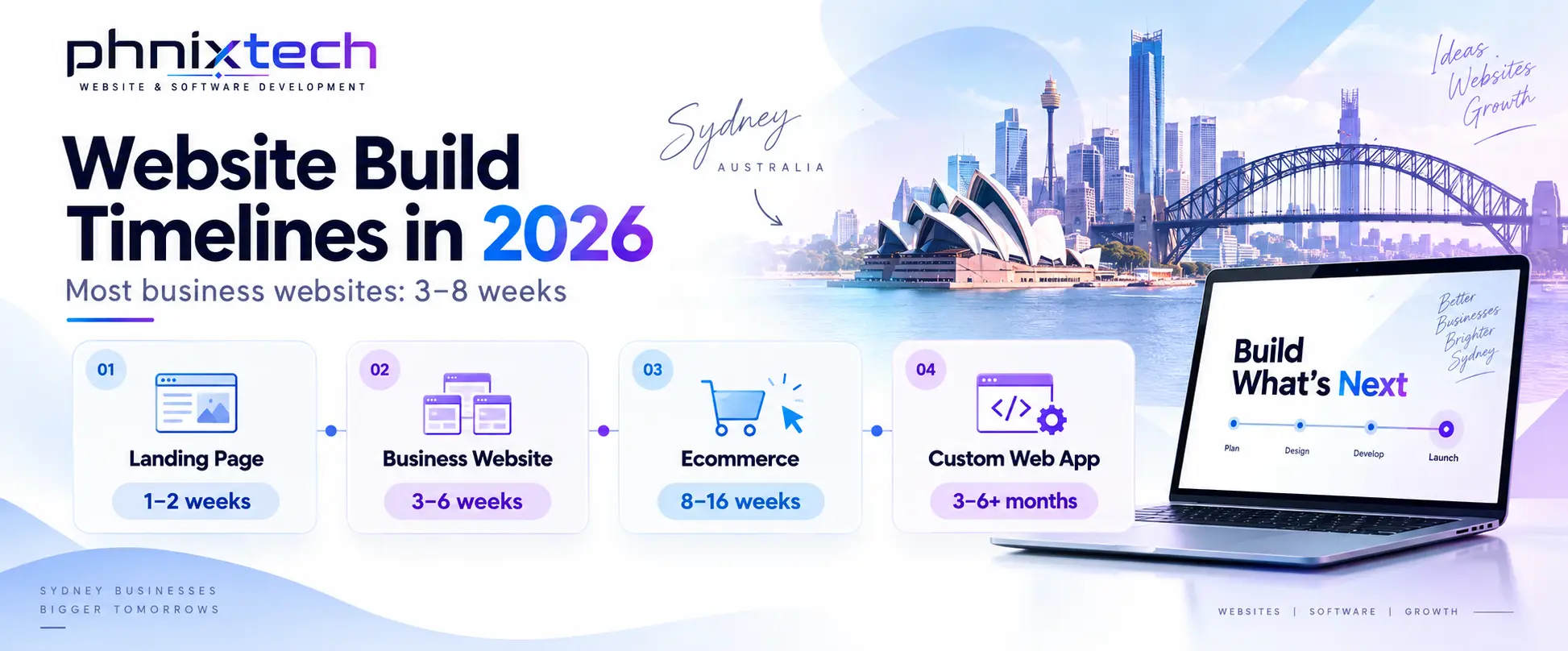
Ask ten agencies how long your website takes to build and you will get ten different answers, because the timeline depends on a handful of variables that shift with every project. Here are the five that move the needle most.
A five-page brochure site is a different job from a fifty-page site with gated resources, a member portal, and multiple contact flows. Each unique page template needs its own design and build attention. Ten pages that share one template take far less time than five pages that each look different. Complexity, not raw page count, is what stretches the clock.
This is the single biggest timeline driver. A brochure site presents information. An ecommerce site adds product catalogues, payment gateways, tax and shipping logic, inventory, and security. A custom web application adds user authentication, databases, and bespoke functionality on top of that. Payments and security alone eat more time on ecommerce builds than most owners expect, which is why an online store realistically needs two to four times the calendar time of a business site.
Here is the uncomfortable truth every agency knows: the number one reason website projects run late is missing content, not design and not code. A designer waiting three days for your product photos just lost three days. Copy that arrives in dribs and drabs stalls entire page builds. Businesses that hand over finished copy, images, and brand files at kickoff routinely finish weeks ahead of those that write it as they go.
The build tool shapes the website design timeline. A well-structured WordPress build using a proven component system moves quickly for most business sites. A fully custom-coded site or web app takes longer because everything is built from the ground up, though it offers total control and scalability. Neither is better in the abstract. The right choice depends on what you actually need the site to do.
Every revision round adds time, and a major change requested in week four can effectively reset part of the clock. A project with one decisive decision-maker moves far faster than one where ten stakeholders each need to weigh in. The approval chain, more than the design itself, often decides whether a custom website build lands on schedule.
Knowing how long it takes to build a website is easier when you can see the phases inside the number. Here is how a Phnix Tech project actually runs, with realistic per-step timeframes for a typical business site. Well-run projects overlap these phases, which is how a sequence that looks like twelve weeks on paper compresses into six to eight in practice.
Timeframe: 3 to 5 days. We start by understanding your business, your customers, and what the site needs to achieve. Goals, target audience, competitor review, sitemap direction, and success metrics all get defined here. Skipping this stage is how projects stall later, so we treat it as foundational, not optional.
Timeframe: 3 to 7 days. Before any visual design, we map the structure. Which pages exist, how they connect, and where each piece of content and call to action sits. Wireframes let you react to layout and flow early, when changes cost minutes instead of days.
Timeframe: 1 to 2 weeks. This is where your brand comes to life visually. We design key page templates, share them for review, and refine based on your feedback. The design feedback loop is usually the longest human-dependent part of any build, so the faster you respond, the faster this stage closes.
Timeframe: 2 to 3 weeks. Our developers turn the approved designs into a working, responsive, SEO-ready website. We build the pages, integrate any forms, bookings, or payment systems, then test across devices, browsers, and key user journeys to catch issues before launch, not after.
Timeframe: 3 to 5 days. We handle domain, hosting, and DNS setup, run final pre-launch checks, and take the site live. You get training so you can manage day-to-day updates, plus post-launch support to keep everything running. Launch is a milestone, not the finish line.
Global timeline guides ignore the local realities that trip up Australian projects. These are the delays we see most often here, and how to sidestep them.
Content bottlenecks lead the list, as they do everywhere. The fix is simple: prepare your copy and images before kickoff, not during. End-of-financial-year timing is a distinctly Australian factor. The run-up to 30 June gets hectic for small businesses juggling tax, reporting, and cash flow, and website feedback slips down the priority list. If you want a mid-year launch, start early or plan around the EOFY crunch. The December to January summer break creates a similar dead zone, when approvals crawl for weeks.
Stakeholder sign-off patterns matter too. Projects with a single empowered decision-maker move quickly. Projects where every director wants a say drag, because each revision round multiplies. Nominate one person to own feedback before you start.
Domain and hosting handover is the quiet time-sink nobody warns you about. Transferring a .au domain, updating DNS, and coordinating with Australian registrars can add days, and DNS changes can take up to 48 hours to propagate fully. Locating your domain login before launch week, rather than during it, saves real time . Scope creep rounds out the list. Adding a booking system or a blog halfway through a build is the fastest way to blow a timeline. Decide the full scope upfront.
You control more of the timeline than you might think. These five habits consistently move launch dates earlier.
Do these five things and you move your project firmly into the on-time category, whatever its size.
DIY builders win the speed race on paper. You can drag, drop, and publish a basic site in a weekend. The catch is what that speed leaves behind.
A site built quickly on a generic template often struggles where it counts: search visibility, page speed, and turning visitors into enquiries. A weak build can be slow to index and quietly bring in zero customers. A professionally built, SEO-ready site takes longer to launch but is engineered to be found on Google and built to convert, which is the whole point of a business website.
| Factor | DIY Builder | Professional Agency |
|---|---|---|
| Time to launch | Days to weeks | 3 to 8 weeks (business site) |
| SEO readiness | Basic, template-limited | Built in from the ground up |
| Conversion focus | Generic | Designed around your goals |
| Ongoing effort | All on you | Supported and maintained |
| Best for | Testing an idea, tight budgets | Businesses serious about growth |
The honest answer: if you need to test a concept cheaply, a builder is faster. If you want a site that earns customers for years, a professional build is the better investment of the extra few weeks.

Every website timeline comes down to scope, content readiness, and how fast decisions get made. Get those three right and your build lands on schedule, whether that is a one-week landing page or a three-month web application.
If you want a dated, realistic timeline for your specific project, talk to a team that has delivered these builds for Sydney businesses. Phnix Tech will scope your site, give you a clear phase plan, and get you a firm quote. Get a free quote or explore our custom website design services in Sydney to see how we work.
FAQ Section related to Website Speed & build
Q1: How long does it take to build a small business website?
A custom small business website typically takes 3 to 8 weeks from kickoff to launch in 2026. Template-based builds can go live in 1 to 3 weeks if your content is ready on day one. The real variable is how fast copy, images, and feedback move.
Q2: Can a website be built in a week?
Yes, for a simple landing page or a template site with content ready upfront. A full business or ecommerce site built properly in a week almost always means rushed and incomplete. For anything beyond a single page, plan on a few weeks to do it well.
Q3: Is a website redesign faster than building a new site?
Often, but not always. A redesign that keeps existing content and structure can move quickly. A redesign that rethinks the sitemap, rewrites copy, and rebuilds functionality can take as long as a new build. The scope of change, not the label, decides the timeline.
Q4: How long does an ecommerce website take to build?
An ecommerce website generally takes 8 to 16 weeks. Product setup, payment and shipping configuration, and security testing consume more time than most owners expect, which is why online stores need considerably longer than brochure sites.
Q5: How much does website design cost in Sydney?
Costs vary by scope. Landing pages start around $800 to $2,500, business websites run roughly $3,000 to $8,000, and ecommerce sites typically start at $8,000 and climb with complexity. For a figure matched to your project, see our pricing details, "how much website design costs in Sydney"
Q6: Do you work with businesses outside Sydney?
Yes. We build and support websites for businesses across Australia, working remotely with clear communication and phase plans, so location is no barrier to a smooth, on-time project.