By Adil Hasan, Co-Founder at Phnix tech, with 10+ years managing and running app & website development company. Last updated: September 2026
Quick answer: To rank your business higher on Google in Sydney, target the suburb-plus-service searches your customers actually type, build a fast website with one strong page per service and region, fully optimise your Google Business Profile, collect genuine reviews every month, and earn links from other Sydney websites. Map-pack gains usually show within 60–90 days; organic rankings take 4–12 months.
Sydney is not one market. It stretches more than 100 km from Palm Beach to Campbelltown, and Google knows it. Someone in Parramatta searching "accountant near me" sees different results from someone in Bondi typing the same words. That's why generic "how to rank on Google" advice often doesn't work here. Your competition isn't all of Sydney. It's the businesses in the few suburbs around your customers.
We're a Sydney digital agency based in Auburn. We've launched 450+ websites and ranked 13,000+ keywords on Google's first page, and this is the order we'd work in if we were starting your SEO from scratch today. There's a 90-day plan at the end.
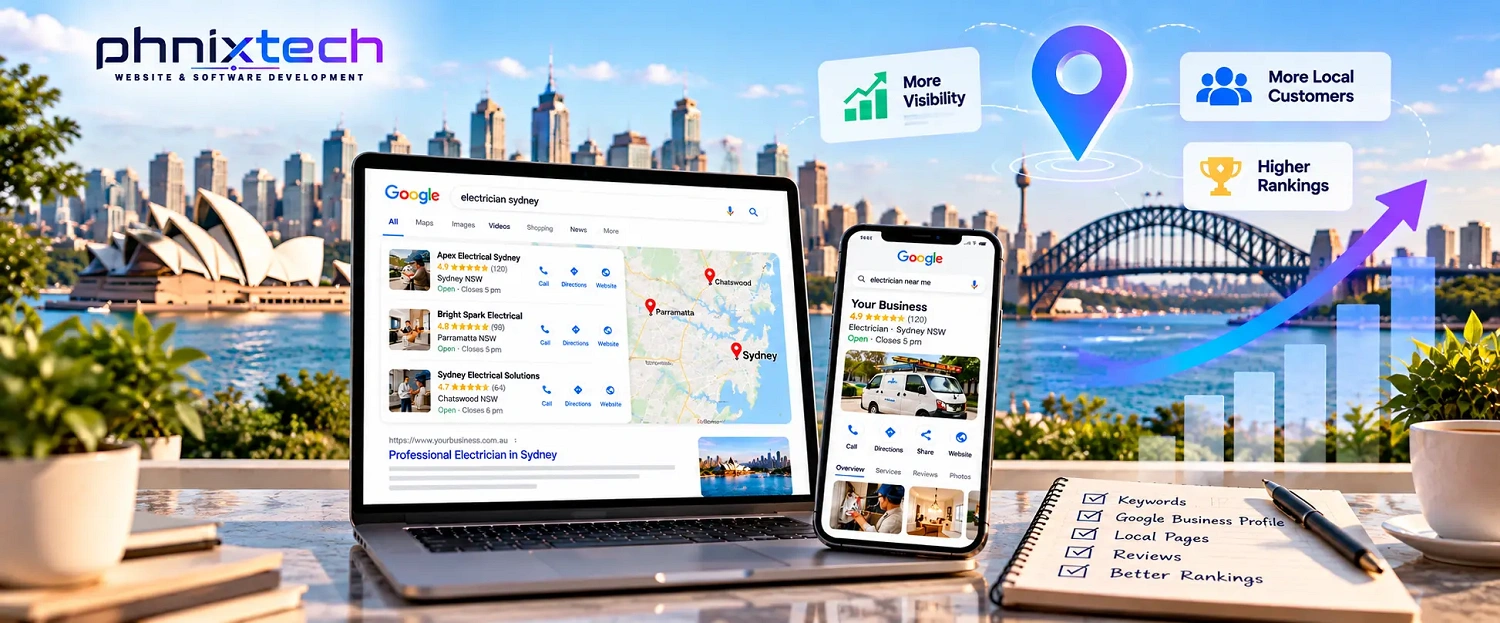
Sydney search results showing how to rank your business higher on Google in Sydney
When a Sydney customer searches for what you sell, Google usually shows two kinds of results:
| Map pack (local pack) | Organic results | |
|---|---|---|
| What it is | The three businesses shown with a map | The standard blue links below |
| Driven mostly by | Google Business Profile, reviews, distance | Your website: content, technical health, links |
| Best for | "Near me" and "[service] [suburb]" searches | Research searches, wider areas, specific services |
| How fast it moves | Weeks to a few months | Several months |
For local results, Google names three factors: relevance (how well you match the search), distance (how close you are to the searcher) and prominence (how well known and trusted you are). Distance matters a lot in a city as spread out as Sydney. A plumber in Penrith is unlikely to show in the map pack for someone in Mosman.
That's why the organic results matter too. A strong website can rank you for suburbs and services where your address alone never would. The best-performing Sydney businesses rank in both, and the steps below cover each one.
Most businesses guess their keywords, and they usually guess too broadly ("plumber Sydney") or use industry jargon customers never type. Start with evidence:
Group what you find into three kinds of keyword:
Give each main keyword one page. If two of your pages go after the same keyword, they compete with each other and both rank lower.
Your Google Business Profile (GBP) is the biggest single lever for the map pack. The essentials:
Sydney tip: Set public-holiday hours for Australia Day, Easter, ANZAC Day, the King's Birthday, Labour Day (NSW, October), Christmas and Boxing Day. Hours that look wrong cost you clicks.
For the full map-pack playbook (citations, review systems and suburb landing pages in depth), see our guide to local SEO services in Sydney.
Your website tells Google what you do and where. Most Sydney businesses get this wrong in one of two ways. Either they have one "Services" page that mentions "Sydney" once, or they have 40 near-identical suburb pages with only the suburb name swapped. Google treats the second as doorway pages and may ignore or penalise them.
What works instead:
A useful test: if you could swap the suburb name for another and nothing else would need to change, the page isn't ready. For an example of a page built around one area, see web design in Parramatta.
Check these on your homepage and every main service page:
areaServed. Choose the most specific subtype, such as Plumber, Dentist or LegalService.
Most local searches happen on phones, often on 4G, on a train or in a car park. A slow, clumsy site loses the customer and the ranking.
If your site is old, built on a page builder that slows it down, or hard to update, it may be cheaper to rebuild than to patch. See our website design services in Sydney and our checklist of must-have small business website features.
Reviews help rankings (prominence) and decide who gets the click. How many reviews you have matters, but so do how recent they are and how often new ones arrive. Twenty reviews from last year will lose to fifteen from the last three months.
Don't buy reviews, offer discounts for 5-star reviews, or have staff review the business. The ACCC has taken action against Australian businesses over fake and incentivised reviews, and Google removes them.
Google cross-checks your business details across the web. Use the same name, address, phone and URL on:
After a move or rebrand, update the old listings too, not just the new ones.
Links from real local websites are one of the strongest signals that you're a trusted Sydney business, for both the map pack and organic results.
One link from a respected Sydney organisation is worth more than a hundred from overseas link farms. Avoid paid link packages.
Blog content captures the research searches your service pages can't, and builds authority across your whole site. Good topics for Sydney businesses:
Write answer-first. Give the direct answer in the opening two sentences, then the detail, with clear headings, short paragraphs and tables where they help. This format is also the one most likely to be quoted in Google's AI Overviews and in AI assistants such as ChatGPT and Perplexity, which more customers are using to shortlist businesses.
Checking your ranking by googling from your office is misleading. You'll only see results for your own location. Instead:
Review everything monthly and move effort to the pages and suburbs where you're close to the top three.
| Timeframe | Focus | Key actions |
|---|---|---|
| Days 1–14 | Foundations | Keyword research, claim and verify GBP, set up Search Console and GA4, audit NAP consistency |
| Days 15–30 | Website | Map one keyword per page, rewrite title tags and H1s, add LocalBusiness schema, fix mobile speed |
| Days 31–60 | Local relevance | Build 2–4 unique region or suburb pages, start the SMS review system, update the top 10 directories |
| Days 61–90 | Authority | Pursue 3–5 local links, publish two answer-first blog posts, run your first geo-grid and Search Console review |
| Ongoing | Momentum | Weekly GBP posts, steady reviews, monthly content, monthly reporting |
How long does it take? In less competitive suburbs and niches, map-pack gains often appear within 4–8 weeks of a properly optimised profile. Organic rankings for competitive Sydney terms (lawyers, dentists, real estate, trades in the CBD and Eastern Suburbs) usually take 6–12 months of steady work.
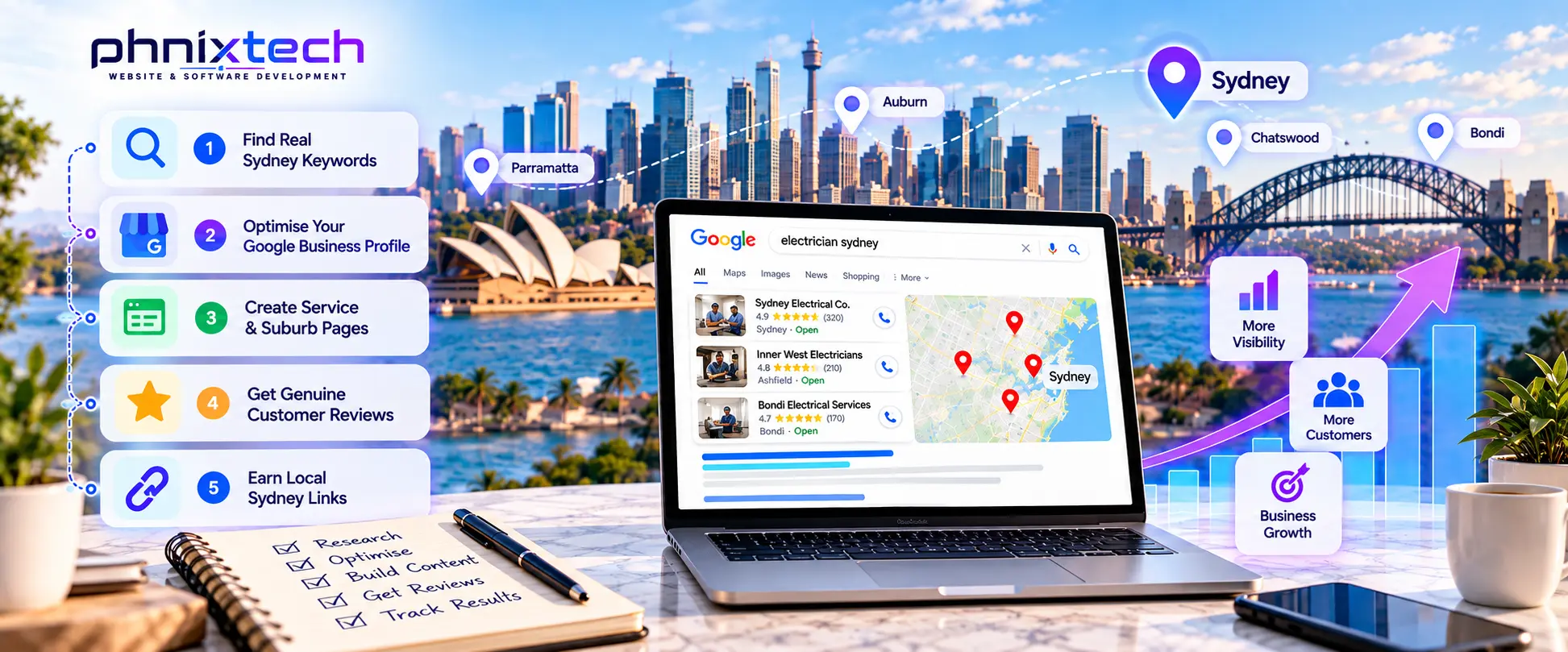
Target suburb-plus-service keywords, build a fast website with a strong page for each service and area, verify and complete your Google Business Profile, collect regular genuine reviews, and earn links from Sydney websites. Map-pack results usually move first, often within two to three months.
Not in the map pack. Distance is a core local ranking factor, so one location usually ranks best in nearby suburbs. You can reach other areas through organic results with strong region pages, service-area settings on your GBP, and content that targets suburb-specific searches.
There's no fixed number. It depends on your competitors. Look at the review counts of the top three businesses for your main search in your suburb and aim to match them, then keep adding reviews every month. Recent reviews count more than a large total that has stopped growing.
You can handle the basics yourself: your Google Business Profile, asking for reviews, directory listings. Keyword mapping, technical fixes, content and link building take specialist time. Many businesses do the basics in-house and bring in an agency once rankings stall.
It isn't required, but it helps. A .com.au tells Google and customers that you're an Australian business, and registering one requires an Australian presence such as an ABN. If you use a .com, make your content, address, phone number and schema clearly Australian.
Getting the basics right is straightforward. Keeping it going every week while running a business is the hard part. Phnix Tech's SEO services in Sydney team, based in Auburn, can audit your site and Google Business Profile, map your keywords, rebuild your service and suburb pages, and set up tracking so you can see exactly which searches and suburbs are sending you calls. Get a free quote →