By Adil Hasan, Co-Founder at Phnix tech, with 10+ years managing and running app & website development company. Last updated: September 2026
So you've got an app idea, and now you're trying to work out two things: what it's going to cost, and who you can actually trust to build it. Both questions are surprisingly hard to answer, because almost everything you'll read online is written by a company that wants your business. This guide is a bit different. Grab a coffee, and let's talk it through like mates who've been through this before.
App development in Sydney usually costs somewhere between $15,000 and $200,000 or more, depending on how complicated your app is. A simple, single purpose app sits at the lower end. A feature heavy or enterprise app climbs quickly. The three things that move the price the most are how many platforms you need, how much custom design goes in, and how much backend and third party integration is involved. Everything else is detail.
Here's the thing that trips people up. You'll ask three companies for a quote on "an app" and get three wildly different numbers back. It's not that someone is ripping you off (usually). It's that "an app" can mean a weekend project or a two year build, and the word alone tells a developer almost nothing.
The honest way to think about it is in tiers. A simple app that does one job well is a completely different animal from a platform that syncs with your existing systems, handles payments, and serves thousands of users. Below is a rough map of the Sydney market, pulled together from what local teams actually charge, so you can see where your idea might land.
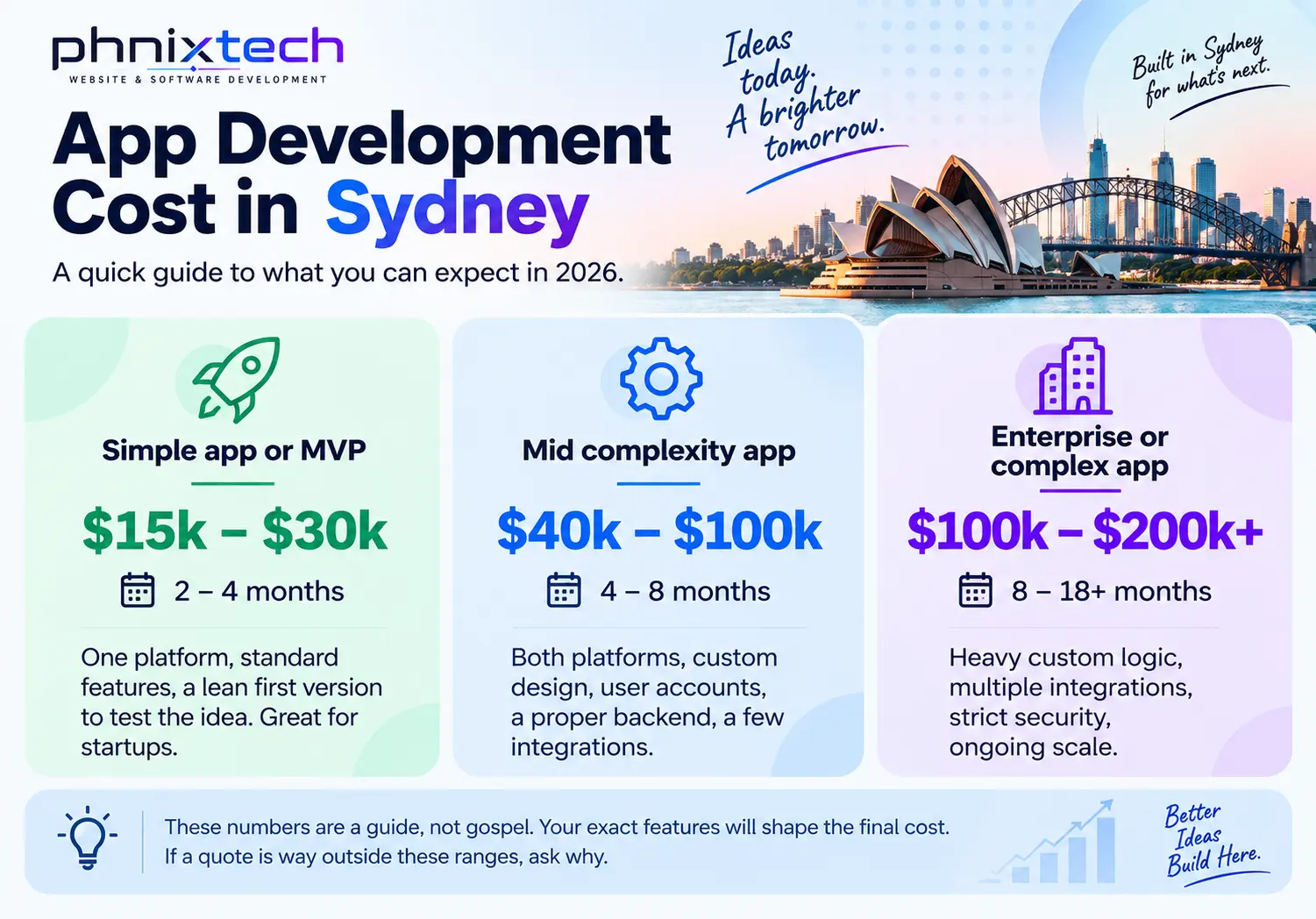
Type of app | Rough cost | Typical timeline | Why it costs what it does |
| Simple app or MVP | $15k to $30k | 2 to 4 months | One platform, standard features, a lean first version to test the idea. Great for startups. See MVP development. |
| Mid complexity app | $40k to $100k | 4 to 8 months | Both platforms, custom design, user accounts, a proper backend, a few integrations. |
| Enterprise or complex app | $100k to $200k+ | 8 to 18+ months | Heavy custom logic, multiple integrations, strict security, ongoing scale. |
None of these numbers are gospel. They shift with your exact features. But if a quote lands far outside the tier that matches your idea, that's your cue to ask why, not to assume you found a bargain or a rip off.
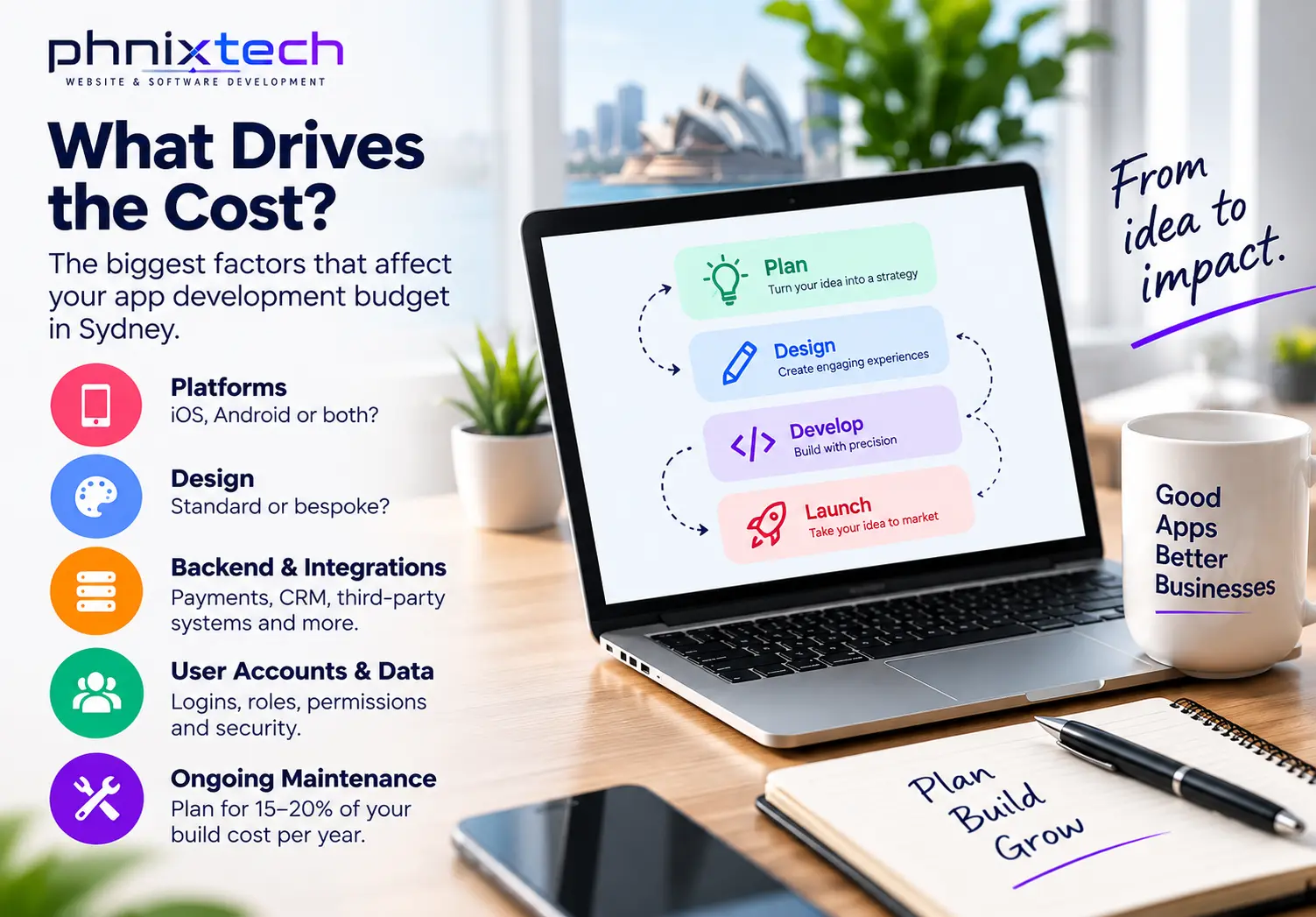
When a developer builds your quote, they're really adding up a handful of big cost levers. Understanding these lets you have a much smarter conversation, and often lets you trim the budget without gutting the app. These are the real mobile app development cost factors:
Building for both iOS and Android roughly increases the work compared to one. If budget is tight, you can start with one platform (whichever your audience actually uses) and add the other later. Have a look at iOS app development and Android app development if you want the platform specific detail.
Using tidy, standard interface patterns is affordable and often better for users. Bespoke animations, custom illustrations, and one of a kind screens look gorgeous and cost real money. Both are valid choices. Just know which you're paying for.
The part users never see is often the priciest. If your app needs to talk to payment systems, a booking engine, a CRM, or your existing database, every one of those connections is extra design, build, and testing.
Logins, profiles, permissions, and anything involving sensitive data all add layers. A simple app for app development Sydney projects might skip most of this. A marketplace or health app cannot.
This one gets forgotten and then hurts. Apps are not "build once and walk away." Plan for roughly 15 to 20 percent of your build cost per year to cover updates, operating system changes, security patches, and small improvements.
Once you know roughly what you're building, the next question is who builds it. You've basically got three routes, and each suits a different situation. There's no single right answer, only the right answer for you. Here's the app development agency vs freelancer vs in-house picture, laid out plainly.
In-house team | Agency | Freelancer | |
| Cost | Highest ongoing cost (salaries, tools, super) | Higher upfront, predictable per project | Lowest, but varies a lot |
| Speed | Slow to hire, fast once settled | Fast, a team is ready to go | Depends entirely on one person's availability |
| Risk | Low day to day, high if key people leave | Low, a team covers each other | Highest, one illness or exit can stall you |
| IP ownership | Cleanest, it's all yours by default | Clear if your contract says so | Must be spelled out, often overlooked |
| Best for | Product companies building for years | Most businesses wanting one solid build | Tiny budgets, small features, quick fixes |
For most Sydney businesses building their first serious app, an agency hits the sweet spot: a full team, a track record you can check, and one contract to hold accountable. A freelancer can be brilliant for a small piece of work. An in-house team only really pays off when the app is your core product and you'll be improving it for years.
This is the part that matters most, so let's slow down. Choosing a developer is less about finding the flashiest portfolio and more about avoiding an expensive mistake. Treat the list below as a buyer's checklist. Work through it before you sign anything, and you'll dodge the problems that sink most projects.
Look at portfolio relevance, not just polish.
Anyone can show pretty screens. Ask to see apps similar to yours in complexity, and ask what problems they solved along the way.
Get the IP and ownership terms in writing.
You should own your app, your code, your designs, and all the accounts. If a contract is fuzzy here, that is a genuine red flag, not a formality.
Nail down post-launch support before you start.
What happens after launch? Ask exactly what's covered, for how long, and what it costs after that. A good partner offers clear post-launch support rather than vanishing at handover.
Check the communication cadence.
How often will you get updates, and through what channel? Weekly demos and a named point of contact beat a monthly email full of jargon.
Ask for references you can actually call.
Not logos on a website. Real clients, real phone numbers. Then ring one and ask what went wrong and how the team handled it.
Make sure there's a proper discovery phase.
Any team that quotes a firm price before understanding your app in detail is guessing. Discovery protects both of you.
Read how they handle changes.
Your idea will evolve. Ask how change requests work, so you're not shocked by the bill when you tweak something mid build.
Red flags to watch for
Some warning signs show up again and again in projects that go sideways. If you spot any of these, slow down and ask hard questions. These are the app developer red flags worth memorising.
Choosing a readily available team is not just sentiment, there are practical upsides. A Sydney app development company gives you a real advantage if you're an Australian product owner. First, the local talent pool is deep, with strong designers and engineers concentrated around the CBD and the growing Tech Central precinct, so you're not scraping the bottom of the barrel for skills.
Second, and people underrate this, is the time zone. When your developers work the same hours you do, a question gets answered in minutes rather than sitting overnight waiting for an offshore team to wake up. Over a long build, that difference in pace adds up to real weeks saved and far less frustration. You can also meet face to face when something important needs sorting, which is hard to put a price on when the pressure is on.
People almost always underestimate how long a good app takes. Rushing it is how you end up with something buggy that you rebuild anyway. Here's a realistic app development timeline for a typical mid complexity build, broken into stages.
Add it up and a solid app often takes four to eight months. Simpler apps are quicker, complex ones take longer, but this gives you an honest baseline to plan around.
From our own work: across the 30+ apps we've built at Phnix Tech, mid complexity projects have typically cost $25K to $60K and taken about 6-8 months from first meeting to launch. We're sharing our real averages so you have at least one honest benchmark to hold quotes up against.
To put all this in context, mobile isn't a fading trend you're late to. The average person now spends around 3.6 hours a day inside apps, according to Sensor Tower's State of Mobile 2026 report (full year 2025 data). A well built app is still one of the most direct lines you have to your customers.
App development in Sydney typically ranges from about $20,000 for a simple app to $200,000 or more for a complex, enterprise grade build. Most small to mid sized business apps land somewhere between $30,000 and $150,000. The final figure depends on features, platforms, and how much custom work is involved.
Most mid complexity apps take four to eight months from first meeting to launch. Simple apps can be ready in three to four months, while large or heavily integrated apps can run well past a year. A proper discovery phase early on gives you a far more reliable timeline than any rough guess.
Offshore can look cheaper on paper, but you often pay for it in slow communication, time zone lag, and harder oversight. If the off-shore developers are available 24*7, you can go with them, after getting a proper agreement signed.
At minimum: a clear scope of work, a payment schedule tied to milestones, explicit intellectual property ownership in your favour, post-launch support terms, and how change requests are handled. If any of these are missing or vague, ask for them in writing before you sign anything.
No, you don't need a prototype, but a clear brief helps enormously. A simple document explaining what your app does, who it's for, and your must-have features is plenty. A good developer expects to shape the detail with you during discovery, so don't feel you have to arrive with everything figured out.
Ready to talk it through?
If you've read this far, you're already ahead of most people who commission an app. When you're ready to put real numbers against your idea, our app development services team offers a free discovery call with no pressure to commit. Full disclosure: we build apps too, so we're not a neutral party. But the advice above is exactly what we'd tell a friend before they spent a dollar.