Reviewed by the Phnix Tech web design team, Auburn NSW · Last updated October 2026
Most Sydney tradies get work from word of mouth. That works until the phone goes quiet, a big competitor moves into your suburb, or a customer searches "electrician near me", finds three other businesses, and never hears your name.
Web design for tradies in Sydney is about fixing that. A good tradie website does one job: it turns people searching on their phones into calls and quote requests. It is not a digital brochure. It is the hardest-working member of your team, and it never takes a day off.
This guide covers what a tradie website needs, how local SEO helps you show up in your suburbs, what it costs, and how to avoid the mistakes that waste money. It is written for tradies and small business owners across Sydney and NSW.
When someone has a burst pipe, a power outage or a leaking roof, they don't browse. They pick up their phone, search, and call one of the first businesses that looks trustworthy.
That moment is decided in seconds. Customers look for three things:
If your online presence fails any of these, the customer moves on to the next result. A Facebook page or a listing on a directory can help, but you don't own those. A website you control lets you build trust, rank for your services and send every enquiry straight to you.

Not every feature matters equally. These are the ones that win jobs.
If you already have a site, check it against this list. Missing two or three items is common and fixable.
Design gets a customer's attention, but the words on the page decide whether they call. Many tradie sites say little more than "we offer quality service at competitive prices", which tells a customer nothing. Strong service pages are specific. Here is a simple structure that works for almost any trade.
Use the words your customers use. Most people search for "leaking tap repair" rather than "plumbing maintenance solutions". Look at how customers describe jobs when they call you, and use the same wording on the page. Keep sentences short and avoid jargon unless you explain it.
If customers keep asking how much a job costs, how long it takes or whether you clean up afterwards, put the answers on the page. This saves you phone time and builds trust. It also helps your page match the questions people type into Google.
You don't have to publish exact prices, but giving a sense of range or what affects the cost helps. Customers are more likely to call a tradie who is upfront than one who hides everything behind "call for a quote".
Every trade has different customers and different worries. A good tradie website speaks to them directly. We design websites for trades businesses across Sydney, and these are the approaches that work.
Emergency work drives plumbing searches, so the phone number, service hours and "emergency" messaging should be impossible to miss. Separate pages for blocked drains, hot water, leaks and gas fitting help you rank for each job type.
Trust and safety come first. Display your licence, mention compliance with Australian standards, and separate residential and commercial work. Pages for switchboard upgrades, safety switches, lighting and EV charger installation target higher-value jobs.
Customers hire builders on the strength of past work. Lead with a project gallery, short project stories, and a clear explanation of how you quote and communicate through a build.
Painting is visual, so photography matters most. Use before-and-after galleries, show interior and exterior work separately, and explain how you handle preparation and clean-up.
Show finished projects by type, such as retaining walls, driveways and gardens. Include a short "how we work" section so customers know what to expect.
Roofing is a high-trust, high-cost job. Cover repairs, restorations, gutters and storm damage, and show how you document the issue before starting work.
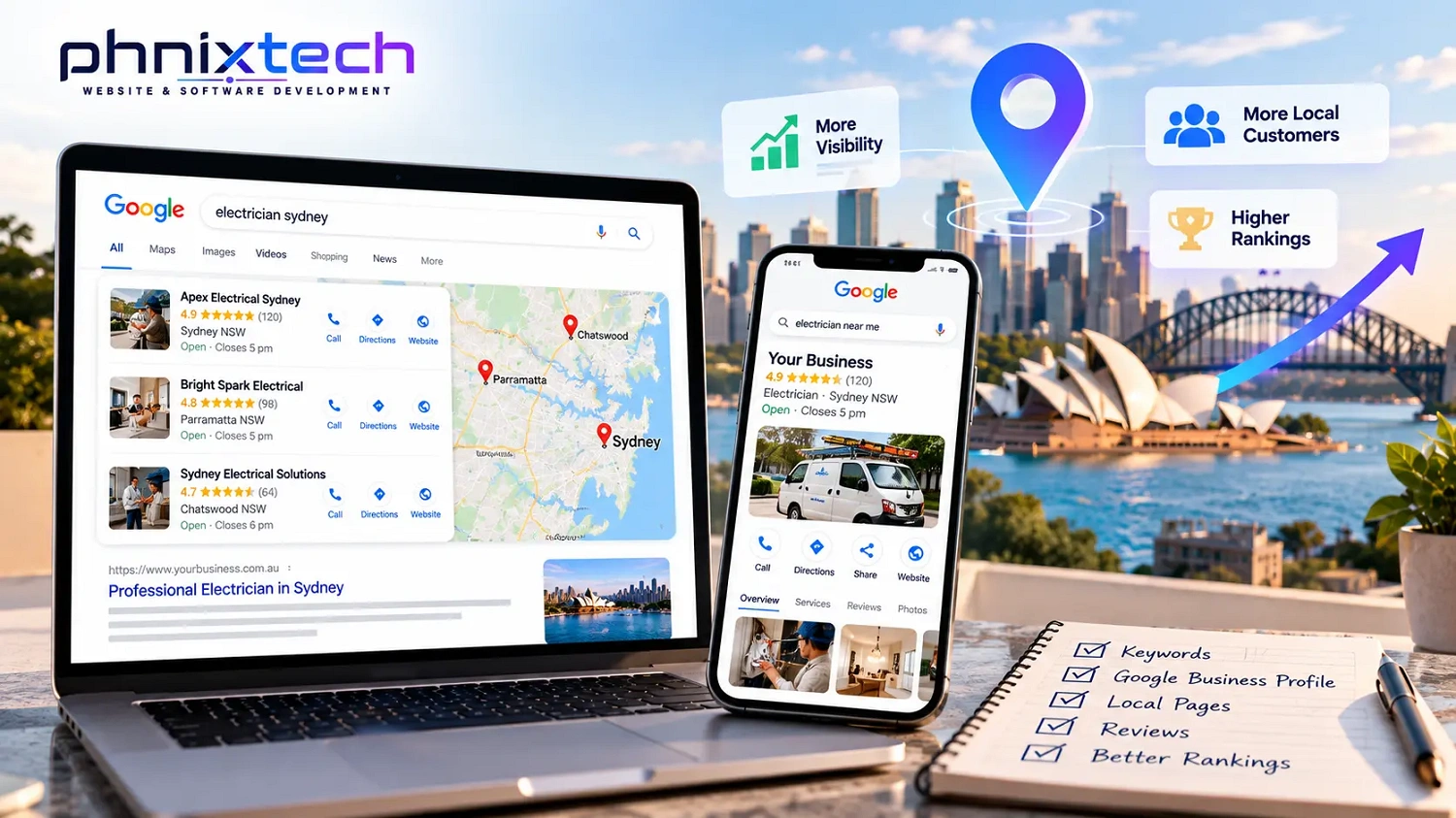
Your customers search by trade and place, like "plumber Parramatta" or "electrician Inner West". Local SEO for tradies is how you appear for those searches. Four things matter most.
Your Google Business Profile is what appears in the map results. Fill in every field: services, service areas, opening hours, photos and a clear description. Use the same business name, address and phone number everywhere online.
Ask every happy customer for a Google review while the job is fresh, and reply to each one. Reviews influence both rankings and whether someone calls you.
Give each core service its own page with a clear title, a plain explanation of the job, photos and a call to action. A page that covers one service well ranks better than one page that lists everything.
Suburb pages can help you rank in the areas you work in, but only when each page has genuine local content. Copying the same text and swapping the suburb name creates thin, duplicate pages that Google may ignore. A useful suburb page mentions real local details, such as the kinds of homes, common issues, recent jobs there and customer reviews from the area. Build them for the suburbs where you want work, not all 600+ at once.
No one can promise a specific Google ranking. Results depend on competition, your location and how consistently the work is done. What a good site does is give you the best foundation: correct structure, fast pages, and the content Google needs to understand what you do and where.
Cost is the first question most tradies ask, so here is a plain answer. Price depends on how many pages you need, how much custom design and content is involved, and whether you want SEO and extras included.
| Type of site | Typical range (AUD) | Best for |
| Small business website | $1,500 to $3,500 | Sole traders and small trades businesses that need a professional site with core service pages |
| Multi-page custom website | $3,500 to $8,000 | Established businesses with multiple services, areas and a larger content library |
| Ecommerce website | $5,000 to $15,000+ | Trades suppliers or businesses selling products online |
These are the ranges Phnix Tech works within. Your quote depends on your goals and scope. We provide fixed-price quotes so you know the cost before work starts.
A website is an investment, so look at what it needs to earn back. Here is a simple example. If your average job is worth $600 and the site brings you three extra jobs a month, that is $1,800 in new work a month. At that rate, a $2,500 site would pay for itself in under two months. Your own numbers will differ, but the same maths applies: divide the cost by your average job value to see how many extra jobs it takes to break even.
After looking at plenty of trades websites, the same problems come up again and again. Fixing even a few of them can make a visible difference.

Many tradies already have a website that someone built years ago, so the real question is whether to fix it or replace it. These signs suggest it's time for a rebuild:
If your site is sound but thin, a redesign that keeps your domain and improves structure, content and speed can be more cost-effective than a rebuild. A good agency will review your current site and tell you honestly which option makes sense. If your site has been around for years and has some Google history, handle the change carefully so you don't lose existing traffic. That means keeping or redirecting your existing URLs where possible.
A website should earn its place, so track a few simple numbers rather than guessing.
Look at these numbers every month or two, and watch the trend rather than any single week. Work is seasonal in many trades, so compare against the same period last year when you can. If calls and quote requests rise while your effort stays the same, the site is paying for itself. If they don't, that's a sign to adjust the content, the call-to-action or the pages you've built.
We keep the process simple, because you're busy on the tools.
The timeline depends on the size of the site and how quickly content is supplied. We'll give you a realistic schedule with your quote.
Phnix Tech is a web design agency based in Auburn, serving businesses across Greater Sydney and NSW. We've launched more than 450 websites, and our clients rank for thousands of keywords on page one of Google.
Here's what that means for you:
You can see examples of our work on the our work page and read what clients say on the testimonials page.
A small business website for a tradie typically costs between $1,500 and $3,500. Larger multi-page sites cost more. The final price depends on pages, design, content and SEO. Phnix Tech provides fixed-price quotes so there are no surprises.
The timeline depends on the size of the site and how quickly you can provide photos, licence details and content. A smaller site is usually faster than a multi-page build. We confirm a realistic schedule when we quote.
Yes. Even referred customers check you online before calling. A professional website backs up the recommendation, and it brings in customers who have never heard of you.
A well-built site gives you the right foundation, with fast pages, clear service pages and local SEO setup. Rankings depend on competition, your suburb and ongoing work, so no honest agency can guarantee a position.
Yes. We can write your service pages and suburb content, or you can supply your own. We recommend including real details about your jobs, because that is what builds trust with customers and search engines.
Yes. We can build on a platform that lets you update text, photos and reviews without technical skills, and we can show you how.
Yes. We can handle updates, hosting and ongoing SEO after launch, or leave you to manage the site yourself.
Social media is useful for showing your work, but you don't control the platform or its rules. A website is something you own. It gives you a place to rank on Google, show your licence and collect quote requests. Most tradies do best with both, using social media to show recent jobs and the website to convert enquiries.
Start with one page for each service you want more work from, plus a home page, an about page and a contact page. If you serve several areas, add suburb pages for the places you most want to work. Quality matters more than volume, so it's better to have a few strong pages than dozens of thin ones.
You should. Ask any agency, including us, to confirm in writing that you own your domain, content and site. That protects you if you ever want to change providers.
If you want a website that brings in more calls and quote requests, we can help. Tell us about your trade and the suburbs you work in, and we'll send a fixed-price quote.
Learn more about our website design in Sydney, SEO services in Sydney and ecommerce development.