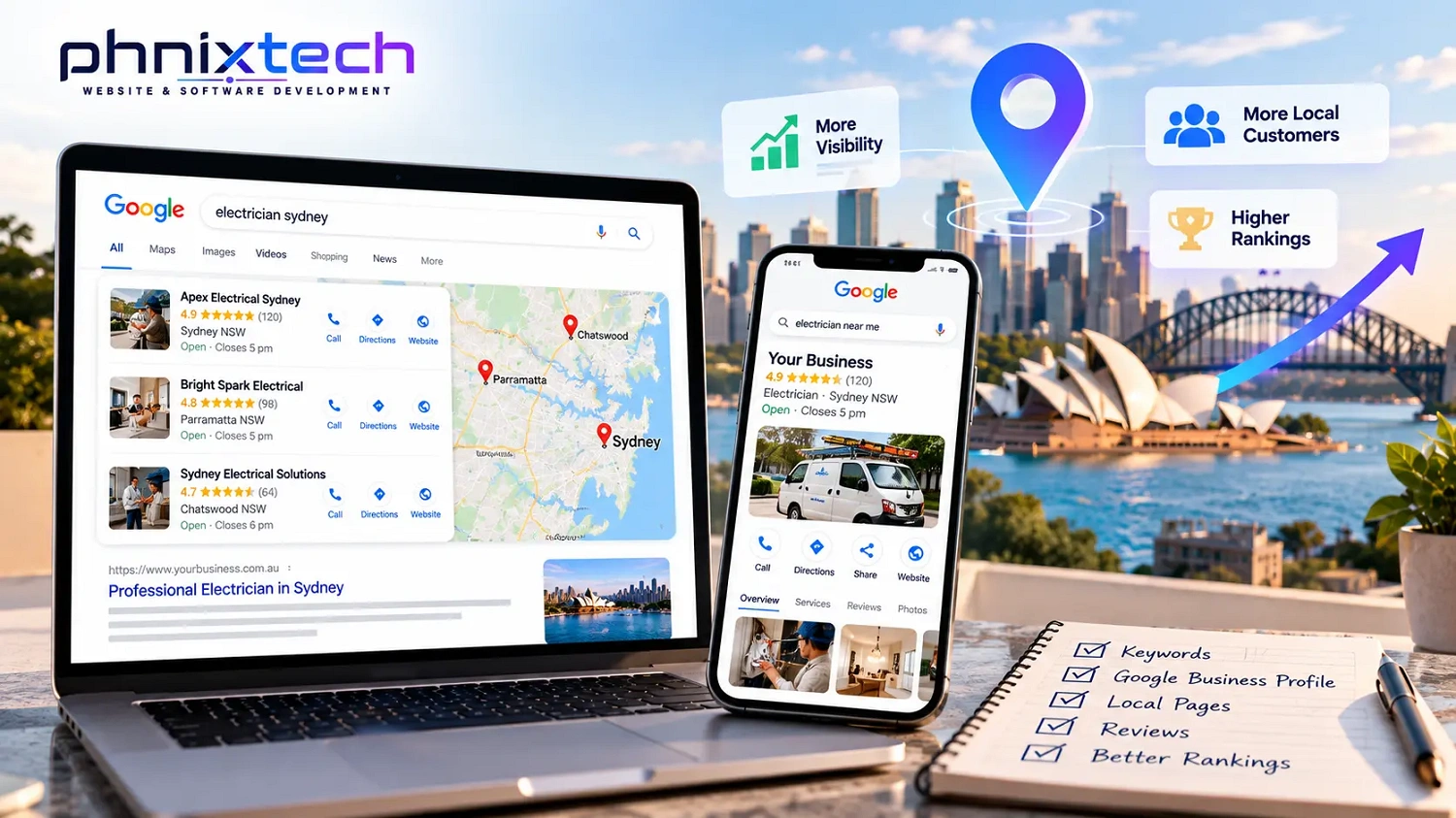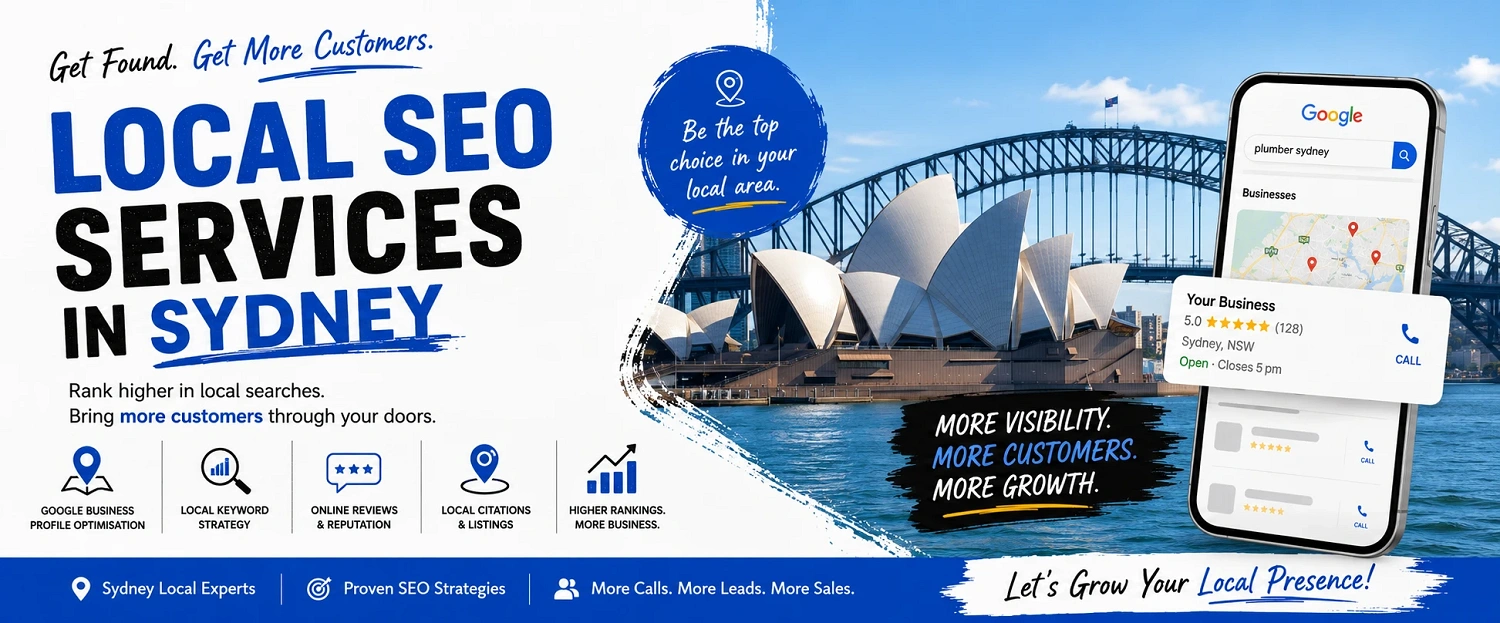
A Sydney plumber ranked seventh for "emergency plumber Parramatta" and wondered why his phone stayed quiet. Position seven on Google gets roughly 5% of the clicks that position one gets, and for local searches, the businesses in the map pack, those top three results with the little map, hoover up the calls before anyone scrolls. That is the entire problem local SEO services Sydney businesses need to solve: not just ranking somewhere, but ranking in the three spots that actually generate phone calls.
Local SEO is not the same beast as regular SEO. It is a specific discipline focused on getting your business found by people searching in your area, at the exact moment they are ready to act. Someone typing "physio near me" or "accountant Chatswood" is not browsing. They are looking to book. Show up in the map pack and you get the call. Show up on page two and you may as well not exist. For any Sydney business that serves a local area, this is the single highest-return corner of digital marketing, and most owners barely touch it.
Here is how it actually works, and how to get it right.
Local SEO is the practice of optimising your online presence so you appear in location-based searches. When someone searches for a service near them, Google decides who to show based on three factors it has stated openly: relevance, distance, and prominence.
Relevance is how well your business matches what the person searched. Distance is how close you are to the searcher or the location they named. Prominence is how well-known and trusted your business appears to be, measured through reviews, citations, links, and your overall web presence.
You cannot change your distance from a searcher. But relevance and prominence are entirely within your control, and that is where local SEO work lives. A cafe in Newtown and a law firm in the CBD both play the same game: send Google clear, consistent signals that you are a real, trusted, relevant business serving that specific area.
The payoff is concrete. According to Google's own research on local search behaviour via Think with Google, a large share of local mobile searches lead to a store visit or a call within 24 hours. These are not tyre-kickers. They are ready-to-buy customers, and local SEO puts you in front of them.

Type any local service into Google on your phone. Notice what fills the screen. Paid ads at the top, then the map with three business listings, then finally the regular blue links far below the fold.
That map with three listings is the local pack, and it is the most valuable real estate in local search. For service businesses, it is very nearly the whole game.
The reason is simple. Most people never scroll past those three results. They tap one, call, and move on. Being ranked first in the regular organic results below the map is worth far less than being third in the map pack itself. This is why a smart local SEO strategy obsesses over map-pack visibility, not just traditional rankings.
Here is the part most Sydney businesses miss. The map pack is hyper-local, which means it changes based on exactly where the searcher is standing. Your business might rank in the pack for someone searching from Parramatta but vanish for someone in Blacktown ten kilometres away. Good SEO services in Sydney track your visibility at the suburb level, across your whole service area, not just from one fixed point. If your agency only reports a single ranking number, they are showing you a fraction of the picture.
Consider what a single map-pack placement is worth in real money. A suburban Sydney physio charging $90 a session who picks up even five extra bookings a week from local search is looking at over $23,000 a year in new revenue from one channel. That is the kind of return good local SEO services Sydney businesses see, and it is why the map pack is worth fighting for rather than treating as a nice-to-have.
Local SEO is not one task. It is a set of coordinated activities that build your relevance and prominence over time. Different Sydney businesses lean on different pieces of it. A tradie living or dying by "near me" searches needs the map pack above all. A multi-location clinic needs suburb pages and citation consistency across every branch. A single cafe needs reviews and a spotless Google Business Profile more than anything else. The mix matters, but the building blocks below are what genuinely move the needle, and here is what to watch for in each.
Your Google Business Profile, still often called Google My Business, is the engine of local SEO. It is the free listing that feeds the map pack. Claiming it is step one. Optimising it is the real work: choosing the right primary and secondary categories, writing a keyword-relevant description, adding real photos, listing your services and hours accurately, and posting updates regularly.
A common mistake is treating the profile as set-and-forget. Businesses that post updates, respond to reviews, and keep information current consistently outrank those with stale profiles. Google rewards active, maintained profiles because they signal a real, operating business.
A citation is any online mention of your business Name, Address, and Phone number, your NAP. Directories like Yellow Pages, True Local, and Localsearch, plus industry-specific sites, all count. The critical rule is consistency. Your NAP must be identical everywhere, character for character.
When Google finds your address listed three slightly different ways across the web, it loses confidence in which is correct, and that uncertainty drags down your local ranking. Cleaning up inconsistent citations is often the fastest win available to an established business that has never done local SEO properly.
Reviews are a direct ranking factor and a powerful conversion driver at the same time. Google weighs the quantity, quality, recency, and even the wording of your reviews. A business with 80 recent, detailed five-star reviews will typically outrank a competitor with 12 old ones.
The tactic that works is simple and most businesses skip it: ask every happy customer for a review, make it effortless with a direct link, and respond to every review you receive, positive or negative. That response activity itself signals engagement to Google.
If you serve multiple areas across Sydney, one generic "areas we serve" page will not rank you in each of them. Businesses that dominate local search build dedicated pages for each suburb or region they target, with genuinely unique content about serving that specific area.
The warning here is real. These pages must have unique, useful content. Copying one template and swapping the suburb name is a tactic Google penalises as doorway pages. A professional website design services in Sydney approach builds these properly, with real local relevance on each page.
Links from other local, relevant websites tell Google your business matters in the community. A link from a Sydney business association, a local news site, a chamber of commerce, or a community sponsorship carries genuine local weight. These are harder to earn than a directory listing, which is exactly why they count for more.
People use these terms interchangeably, and that confusion costs businesses money. They are related but not identical, and knowing which you need shapes where your budget goes.
Organic SEO is about ranking in the standard search results for any query, regardless of location. If you sell a product nationally or run a blog, organic SEO is your focus. Local SEO is specifically about ranking in location-based searches and the map pack, driven heavily by your Google Business Profile.
A dentist in Bondi needs local SEO above all else, because their customers are nearby and searching locally. An online store shipping Australia-wide needs organic SEO, because location is irrelevant to their sale. Many businesses need both, but the ratio differs. A full digital marketing agency in Sydney worth its fee will tell you honestly which mix suits your business rather than selling you everything.
The misconception worth killing: local SEO is not "SEO lite" or a cheaper version of the real thing. It is a distinct discipline with its own tactics, tools, and ranking factors. Treating it as an afterthought is why so many local businesses stay invisible.
You do not need to wait for an agency to begin. Here is a practical sequence any Sydney business owner can start immediately.
Step one, claim and fully complete your Google Business Profile. Every field, real photos, accurate hours, correct categories. This alone puts you ahead of businesses with half-finished profiles.
Step two, audit your NAP everywhere it appears online. Make your business name, address, and phone number identical across every listing. Fix the inconsistencies you find.
Step three, build citations on the major Australian directories: Yellow Pages, True Local, Localsearch, Hotfrog, and Yelp. Same NAP every time.
Step four, launch a review engine. Ask every satisfied customer, give them a direct link, and respond to all reviews within a day or two.
Step five, add genuine local content to your website. Name the suburbs you serve, mention local landmarks, and if you serve several areas, plan proper suburb pages.
Step six, measure at the suburb level. Use a free tool like Google Search Console to track which local queries bring you traffic, and watch your map-pack visibility across your service area, not just from your office.
Work these in order. Each builds on the last, and the first three alone will move most businesses that have never done local SEO before.
Pricing varies with how competitive your industry and area are, but here are realistic 2026 ranges for professionally managed local SEO in Sydney.
A local SEO campaign for a small business in a single location, covering GBP optimisation, citations, and review management, typically runs $750 to $1,500 per month. This suits a suburban business with modest competition.
A more competitive campaign, targeting multiple suburbs with content, suburb pages, and active link building, usually sits at $1,500 to $3,000 per month. This is where most established Sydney service businesses land.
Highly competitive categories, think personal injury law, cosmetic surgery, or trades in dense metro areas, can run $3,000 or more per month, because the effort required to outrank entrenched competitors is genuinely higher.
A one-off local SEO audit, if you want to start with a diagnosis, generally costs from $500. Be cautious of anyone offering local SEO for $200 a month. At that price, the work is either automated citation spam or simply not being done, and both can hurt more than help.
A Sydney electrician paid an agency for six months and saw nothing. When we looked, the problem was obvious: the agency had been chasing broad organic keywords like "electrical services" while completely ignoring his Google Business Profile, which sat unclaimed and unoptimised the entire time.
That is the mistake, and it is everywhere. Pouring effort into traditional SEO while neglecting the Google Business Profile that actually drives the map
pack.

For a local service business, the GBP is the single most important asset in local search. It is free, it is fast to improve, and it directly feeds the results that generate calls. Any local SEO effort that does not start with the profile is building on sand. When you talk to an agency, ask what they do with your GBP first. If the answer is vague, keep looking. This one question filters out a surprising number of the operators pitching local SEO across Sydney.
Everyone claims results. Here is how to separate the agencies that deliver from the ones that sell.
Ask them to show suburb-level ranking data for a current client, not a single vanity keyword. Real local SEO agencies track map-pack visibility across a service area. If they can only show you one ranking, their reporting is too shallow.
Ask what they do about your Google Business Profile specifically. The answer should be detailed and immediate, because it is the foundation.
Ask how they handle citations and NAP consistency. A good agency audits and cleans up your existing citations before building new ones.
Ask whether they build real suburb pages with unique content, or templated copies. The wrong answer here can get your site penalised.
Ask about reporting. You want to see map-pack movement, calls, direction requests, and website clicks, the metrics that reflect actual business, not just a ranking chart. Look for agencies that hold experience of ranking keywords on local google maps and GMB, as a baseline signal of competence.
Honesty matters here, because the timeline is where expectations most often break. Local SEO is not instant, but it is usually faster than traditional organic SEO.
A newly optimised Google Business Profile, combined with citation work, can start improving your map-pack visibility within four to eight weeks. That is quicker than most organic rankings, which is one reason local SEO is such good value for local businesses.
Fuller results, ranking consistently in the map pack across your whole service area, competing for the most valuable local terms, generally take three to six months of consistent work, and continue improving from there. The businesses that win are the ones that treat local SEO as ongoing maintenance, not a one-time project. Your competitors do not stop, so neither can you.
Anyone guaranteeing you the top map-pack spot within days is either misunderstanding how Google works or hoping you do. Nobody controls the algorithm. Steady, correct work is what wins.
Local SEO comes down to a single idea: be the business Google shows when a nearby customer is ready to buy. That means a fully optimised Google Business Profile, consistent citations, genuine reviews, real local content, and the patience to let it compound. Do that, and you stop competing for scraps on page two and start owning the map pack that actually rings your phone.
Start with the six-step framework above. Claim your profile, fix your NAP, build citations, and get reviews flowing. Those first moves alone will put you ahead of most of your local competition, because most of them have never done it properly.
If you would rather have experts handle it while you run your business, Phnix Tech provides local SEO services Sydney businesses rely on to climb the map pack and turn local searches into booked jobs. Book a free local SEO audit with Phnix Tech and find out exactly where your local visibility stands and how to fix it.
Local SEO services optimise your online presence to rank in location-based searches and the Google map pack. They include Google Business Profile optimisation, citation building, review management, local content, and suburb-level pages, all aimed at getting your business found by nearby customers ready to buy.
A small single-location campaign typically costs $750 to $1,500 per month, a competitive multi-suburb campaign $1,500 to $3,000, and highly competitive categories $3,000 or more. A one-off audit starts from around $500. Avoid $200-per-month offers, which usually mean automated spam.
Map-pack visibility can start improving within four to eight weeks of optimising your Google Business Profile and citations. Fuller results across your service area usually take three to six months of consistent work, then continue improving from there.
Regular (organic) SEO targets rankings in standard search results regardless of location. Local SEO specifically targets location-based searches and the map pack, driven heavily by your Google Business Profile. Local businesses need local SEO most; national sellers need organic SEO.
No, but it is the foundation of it. Google Business Profile is the free listing that feeds the map pack, and optimising it is the single most important local SEO task. Full local SEO also includes citations, reviews, local content, and link building.
Yes. Even a single-location business relies on being found by nearby searchers at the moment they are ready to buy. A well-optimised Google Business Profile and consistent citations can significantly increase calls and visits for a single-location Sydney business.
Common reasons include an unclaimed or unoptimised Google Business Profile, inconsistent NAP across the web, too few recent reviews, weak local relevance on your website, or strong entrenched competition. Fixing the profile and NAP first usually produces the fastest improvement.
Yes, the basics are very doable. Claim and complete your Google Business Profile, make your NAP consistent everywhere, build citations on major Australian directories, and gather genuine reviews. Competitive markets and suburb-page strategies are where professional help pays off.